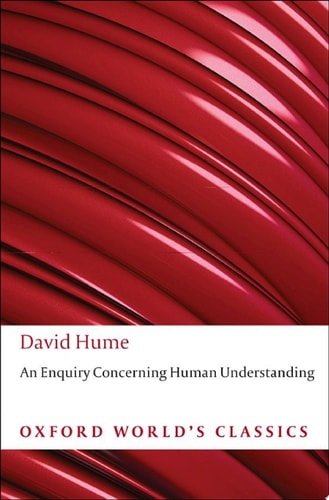
An Enquiry concerning Human Understanding
0
0
As an Amazon Associate and affiliate partner, Menrva Books earns from qualifying purchases. Learn more
Author Description
'Commit it then to the flames: for it can contain nothing but sophistry and illusion.' Thus ends David Hume's Enquiry concerning Human Understanding, the definitive statement of the greatest philosopher in the English language. His arguments in support of reasoning from experience, and against the 'sophistry and illusion' of religiously inspired philosophical fantasies, caused controversy in the eighteenth century and are strikingly relevant today, when faith and science continue to clash. The Enquiry considers the origin and processes of human thought, reaching the stark conclusion that we can have no ultimate understanding of the physical world, or indeed our own minds. In either sphere we must depend on instinctive learning from experience, recognizing our animal nature and the limits of reason. Hume's calm and open-minded scepticism thus aims to provide a new basis for science, liberating us from the 'superstition' of false metaphysics and religion. His Enquiry remains one of the best introductions to the study of philosophy, and this edition places it in its historical and philosophical context. ABOUT THE SERIES: For over 100 years Oxford World's Classics has made available the widest range of literature from around the globe. Each affordable volume reflects Oxford's commitment to scholarship, providing the most accurate text plus a wealth of other valuable features, including expert introductions by leading authorities, helpful notes to clarify the text, up-to-date bibliographies for further study, and much more.
Menrva's Summary
THE THESIS
David Hume investigates the limits of human reason and the validity of knowledge derived from experience rather than metaphysical speculation. As a central figure of the Scottish Enlightenment, Hume utilizes a skeptical framework to challenge traditional religious and metaphysical assumptions. He argues that human understanding is fundamentally rooted in habit and custom rather than rational deduction, proposing that science must be grounded in empirical observation to avoid the pitfalls of superstition.
THE SCOPE MAP
What You Will Find
- Analysis of the origin and processes of human thought
- Critique of causality and induction
- Examination of the relationship between faith and scientific inquiry
Scope Limits
- Does not provide a comprehensive system of ethics or political theory
- Does not offer a definitive proof for the existence of an external physical world
THE AUTHORITY PERSPECTIVE
Scholars and students recognize this text as a foundational work of modern philosophy that remains highly accessible for its clarity of argument. Readers frequently note that while the prose is elegant, the skeptical conclusions regarding human knowledge require careful, deliberate study to fully grasp.
Page Count:
304
Publication Date:
2007-01-01
Publisher:
OUP Oxford
ISBN-10:
0191607363
ISBN-13:
9780191607363
Non-Fiction
Philosophy
English
Enlightenment
Epistemology
English & College Success
Empiricism
Community Tags
Similar Books