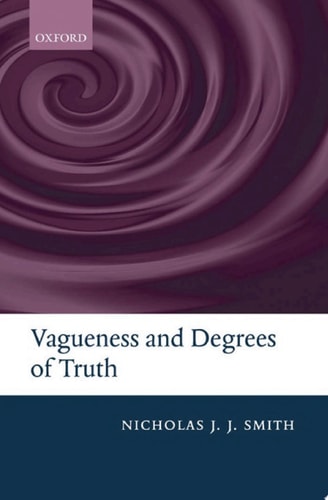
Vagueness and Degrees of Truth
0
0
As an Amazon Associate and affiliate partner, Menrva Books earns from qualifying purchases. Learn more
Author Description
In Vagueness and Degrees of Truth, Nicholas Smith develops a new theory of vagueness: fuzzy plurivaluationism. A predicate is said to be vague if there is no sharply defined boundary between the things to which it applies and the things to which it does not apply. For example, 'heavy' is vague in a way that 'weighs over 20 kilograms' is not. A great many predicates - both in everyday talk, and in a wide array of theoretical vocabularies, from law to psychology to engineering - are vague. Smith argues, on the basis of a detailed account of the defining features of vagueness, that an accurate theory of vagueness must involve the idea that truth comes in degrees. The core idea of degrees of truth is that while some sentences are true and some are false, others possess intermediate truth values: they are truer than the false sentences, but not as true as the true ones. Degree-theoretic treatments of vagueness have been proposed in the past, but all have encountered significant objections. In light of these, Smith develops a new type of degree theory. Its innovations include a definition of logical consequence that allows the derivation of a classical consequence relation from the degree-theoretic semantics, a unified account of degrees of truth and subjective probabilities, and the incorporation of semantic indeterminacy - the view that vague statements need not have unique meanings - into the degree-theoretic framework. As well as being essential reading for those working on vagueness, Smith's book provides an excellent entry-point for newcomers to the era - both from elsewhere in philosophy, and from computer science, logic and engineering. It contains a thorough introduction to existing theories of vagueness and to the requisite logical background.
Menrva's Summary
THE THESIS
This book investigates the nature of vagueness in language and proposes a new theoretical framework, fuzzy plurivaluationism, to account for predicates that lack sharply defined boundaries. Nicholas J. J. Smith, a philosopher specializing in logic and language, utilizes a formal semantic approach to argue that an accurate understanding of vagueness requires the adoption of degrees of truth. By synthesizing existing literature with his own innovations, Smith addresses the limitations of previous degree-theoretic models to provide a more robust account of how vague statements function in both everyday and technical discourse.
THE SCOPE MAP
What You Will Find
- A comprehensive survey of existing theories of vagueness and their associated logical challenges.
- The development of fuzzy plurivaluationism as a novel semantic framework.
- A formal definition of logical consequence derived from degree-theoretic semantics.
- An integration of subjective probabilities and semantic indeterminacy into the theory.
Scope Limits
- The text focuses primarily on formal and philosophical logic, rather than empirical linguistic data or sociolinguistic usage.
- It does not provide an exhaustive history of all non-Western approaches to vague logic.
THE AUTHORITY PERSPECTIVE
Experts in the field of analytic philosophy and logic recognize this work as a significant contribution to the ongoing debate regarding semantic indeterminacy. Readers frequently note the technical density of the prose, which requires a foundational understanding of formal logic to fully grasp the proposed semantic innovations.
Page Count:
364
Publication Date:
2008-01-01
Publisher:
OUP Oxford
ISBN-10:
0191607924
ISBN-13:
9780191607929
Philosophy
Epistemology
Logic
Truth
Semantics
In literature
Logic & Critical Reasoning
Linguistics
Metaphysics
Community Tags
Other Editions(3)

Similar Books





Reader Comments
Share Your Thoughts
No comments yet. Be the first to share your thoughts!