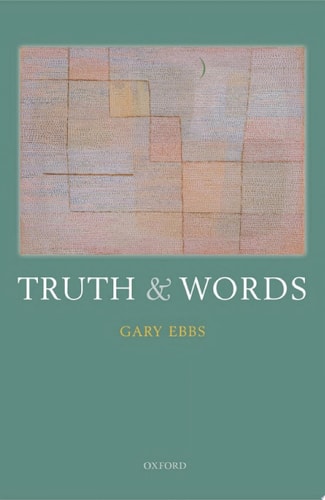
Truth and Words
0
0
As an Amazon Associate and affiliate partner, Menrva Books earns from qualifying purchases. Learn more
Author Description
To clarify and facilitate our inquiries we need to define a disquotational truth predicate that we are directly licensed to apply not only to our own sentences as we use them now, but also to other speakers' sentences and our own sentences as we used them in the past. The conventional wisdom is that there can be no such truth predicate. For it appears that the only instances of the disquotational pattern that we are directly licensed to accept are those that define 'is true' for our own sentences as we use them now. Gary Ebbs shows that this appearance is illusory. He constructs an account of words that licenses us to rely not only on formal (spelling-based) identifications of our own words, but also on our non-deliberative practical identifications of other speakers' words and of our own words as we used them in the past. To overturn the conventional wisdom about disquotational truth, Ebbs argues, we need only combine this account of words with our disquotational definitions of truth for sentences as we use them now. The result radically transforms our understanding of truth and related topics, including anti-individualism, self-knowledge, and the intersubjectivity of logic.
Menrva's Summary
THE THESIS
This book investigates whether a disquotational truth predicate can be legitimately applied to sentences beyond those used by a speaker in the present moment. Gary Ebbs, a philosopher specializing in the philosophy of language and logic, challenges the conventional wisdom that such a predicate is impossible. He argues that by refining our account of how words are identified across different speakers and time periods, we can expand the scope of disquotational truth without falling into logical contradiction.
THE SCOPE MAP
What You Will Find
- A re-evaluation of disquotational truth patterns
- An account of non-deliberative practical word identification
- Analysis of anti-individualism and self-knowledge
- Implications for the intersubjectivity of logic
Scope Limits
- The text does not provide a general introduction to truth theories
- It does not address non-linguistic or correspondence theories of truth in detail
THE AUTHORITY PERSPECTIVE
Experts in analytic philosophy recognize this work as a rigorous challenge to established views on truth predicates. Readers frequently note the high level of technical density in the prose, making it most suitable for those with a background in formal logic and philosophy of language.
Page Count:
353
Publication Date:
2011-01-01
Publisher:
OUP Oxford
ISBN-10:
0191619728
ISBN-13:
9780191619724
Philosophy
Logic & Critical Reasoning
Epistemology
Truth
Language and logic
Metaphysics
Logic
Language