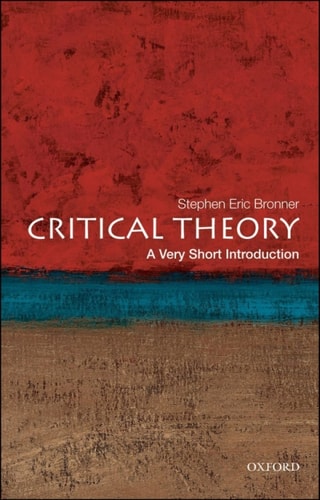
Critical Theory: A Very Short Introduction
0
0
As an Amazon Associate and affiliate partner, Menrva Books earns from qualifying purchases. Learn more
Author Description
Critical Theory Emerged In The 1920s From The Work Of The Frankfurt School, The Circle Of German-jewish Academics Who Sought To Diagnose -- And, If At All Possible, Cure -- The Ills Of Society, Particularly Fascism And Capitalism. In This Book, Stephen Eric Bronner Provides Sketches Of Leading Representatives Of The Critical Tradition (such As George Lukács And Ernst Bloch, Theodor Adorno And Walter Benjamin, Herbert Marcuse And Jurgen Habermas) As Well As Many Of Its Seminal Texts And Empirical Investigations. This Very Short Introduction Sheds Light On The Cluster Of Concepts And Themes That Set Critical Theory Apart From Its More Traditional Philosophical Competitors. Bronner Explains And Discusses Concepts Such As Method And Agency, Alienation And Reification, The Culture Industry And Repressive Tolerance, Non-identity And Utopia. He Argues For The Introduction Of New Categories And Perspectives For Illuminating The Obstacles To Progressive Change And Focusing Upon Hidden Transformative Possibilities. In This Newly Updated Second Edition, Bronner Targets New Academic Interests, Broadens His Argument, And Adapts It To A Global Society Amid The Resurgence Of Right-wing Politics And Neo-fascist Movements.
Menrva's Summary
THE THESIS
This work investigates the origins, core concepts, and contemporary relevance of Critical Theory as a diagnostic tool for understanding societal ills. Stephen Eric Bronner, a distinguished scholar of political theory, utilizes his expertise to synthesize the complex history of the Frankfurt School. He presents a framework that connects historical philosophical inquiry with modern political challenges, arguing that the tradition remains vital for identifying barriers to progressive social change.
THE SCOPE MAP
What You Will Find
- Biographical sketches of key figures including Adorno, Benjamin, Marcuse, and Habermas.
- Analysis of foundational concepts such as reification, the culture industry, and non-identity.
- Examination of the evolution of the tradition from the 1920s to the current era of neo-fascist resurgence.
Scope Limits
- The text does not provide an exhaustive history of every minor contributor to the Frankfurt School.
- It does not offer a comprehensive manual for political activism or policy implementation.
THE AUTHORITY PERSPECTIVE
Experts recognize this volume as a concise and accessible entry point for students and general readers interested in the Frankfurt School. Readers frequently note that while the prose is clear, the density of the philosophical concepts requires careful and deliberate study.
Page Count:
168
Publication Date:
2017-01-01
Publisher:
Oxford University Press
ISBN-10:
0190692685
ISBN-13:
9780190692681
Philosophy
Critical Theory
Intellectual History
Sociology