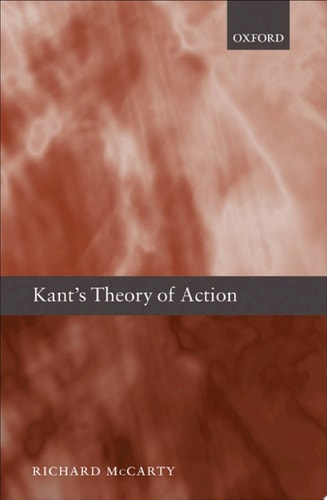
Kant's Theory of Action
0
0
As an Amazon Associate and affiliate partner, Menrva Books earns from qualifying purchases. Learn more
Author Description
The theory of action underlying Immanuel Kant's ethical theory is the subject of this book. What 'maxims' are, and how we act on maxims, are explained here in light of both the historical context of Kant's thought, and his classroom lectures on psychology and ethics. Arguing against the current of much recent scholarship, Richard McCarty makes a strong case for interpreting Kant as having embraced psychological determinism, a version of the 'belief-desire model' of human motivation, and a literal, 'two-worlds' metaphysics. On this interpretation, actions in the sensible world are always effects of prior psychological causes. Their explaining causal laws are the maxims of agents' characters. And agents act freely if, acting also in an intelligible world, what they do there results in their having the characters they have here, in the sensible world. McCarty additionally shows how this interpretation is fruitful for solving familiar problems perennially plaguing Kant's moral psychology.
Menrva's Summary
THE THESIS
This book investigates the underlying theory of action within Immanuel Kant's ethical framework by examining the nature of maxims and human motivation. Richard McCarty, a scholar of Kantian philosophy, utilizes historical context and Kant's own classroom lectures on psychology to challenge prevailing interpretations. He argues that Kant embraced psychological determinism, a belief-desire model of motivation, and a two-worlds metaphysical structure to explain human agency.
THE SCOPE MAP
What You Will Find
- Analysis of Kantian maxims and their role in human action
- Examination of Kant's lectures on psychology and ethics
- Argumentation for a two-worlds metaphysical interpretation
- Solutions to persistent problems in Kantian moral psychology
Scope Limits
- Does not provide a general introduction to Kantian ethics for lay readers
- Focuses specifically on action theory rather than political or aesthetic philosophy
THE AUTHORITY PERSPECTIVE
Scholars frequently note that this text provides a rigorous, albeit controversial, challenge to standard contemporary readings of Kant's moral psychology. Experts highlight the work as a dense, specialized contribution that is most useful for advanced students and researchers in the field of Kantian studies.
Page Count:
275
Publication Date:
2009-01-01
Publisher:
OUP Oxford
ISBN-10:
019160996X
ISBN-13:
9780191609961
Philosophy
Ethics
Kant
Metaphysics
Act Philosophy
Community Tags
Other Editions(3)
Similar Books