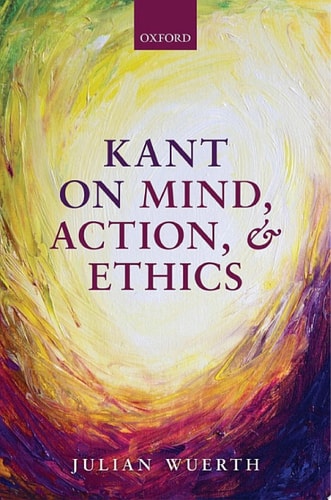
Kant on Mind, Action, and Ethics
0
0
As an Amazon Associate and affiliate partner, Menrva Books earns from qualifying purchases. Learn more
Author Description
In this book Julian Wuerth offers a radically new interpretation of Kant's theories of mind, action, and ethics. As the author of a Copernican revolution in philosophy, Kant grounded his philosophy in his positive theory of the mind, which remains an enigma two centuries later. Wuerth's original interpretation of Kant's theory of mind consults a far wider range of Kant's recorded thought than previous interpretations, revealing a fascinating evolution in Kant's thought in the decades before and after his 1781 Critique. Starting in the 1760s, Kant recognized the unique status of our epistemic contact to ourselves. This is the sole instance of our immediate epistemic contact with a substance, of being a substance, and it is the sole instance of epistemic contact with something other than the particular states of inner sense. Contrary to empiricists, Kant thus rejects the reduction of the self to a bundle of mental states of inner sense. But Kant also rejects the rational psychologists' assumption that the souls substantiality and simplicity implies its permanence, incorruptibility, and immortality. As Kant developed his transcendental idealism, he eventually pinpointed the source of their errors, a source neither unique to a particular, historical school, nor random. It is instead a deep, natural, and timeless transcendental confusion. Kants new account of substance allows him to draw new distinctions in kind between sensibility and understanding and between phenomenal and noumenal substance, setting the stage for a transcendental argument that only at the phenomenal level do substantiality and simplicity imply permanence and incorruptibility. Wuerth next undertakes a groundbreaking study of Kant's theory of action and ethics. He first maps Kant's notoriously vast and complex system of the minds powers, drawing on all of Kant's recorded thought. This system structures Kant's philosophy as a whole and so provides crucial insights into this whole and its parts, includin
Menrva's Summary
THE THESIS
This book investigates the core question of how Kant’s positive theory of the mind serves as the foundational structure for his broader theories of action and ethics. Julian Wuerth, a scholar of Kantian philosophy, utilizes a comprehensive analysis of Kant’s recorded thought, including texts spanning from the 1760s through the post-1781 period. The author argues that Kant’s unique understanding of epistemic self-contact allows for a rejection of both empiricist bundle theories and rationalist assumptions regarding the soul, ultimately proposing a new interpretation of transcendental idealism.
THE SCOPE MAP
What You Will Find
- A systematic mapping of Kant’s complex hierarchy of mental powers.
- An analysis of the distinction between phenomenal and noumenal substance.
- A historical examination of Kant’s evolving thought across several decades.
Scope Limits
- The text focuses primarily on the metaphysical and psychological foundations of Kant’s work rather than a general introduction to his political philosophy.
THE AUTHORITY PERSPECTIVE
Scholars and students of Kantian studies frequently note the high academic density and rigorous textual analysis present throughout the work. Experts highlight this as a significant contribution to the field that challenges long-standing interpretations of Kant’s transcendental arguments.
Page Count:
365
Publication Date:
2014-01-01
Publisher:
OUP Oxford
ISBN-10:
0191026441
ISBN-13:
9780191026447
Philosophy
History & Surveys
Epistemology
Ethics
Kant
Academic
Metaphysics
Community Tags
Other Editions(3)

Similar Books




Reader Comments
Share Your Thoughts
No comments yet. Be the first to share your thoughts!