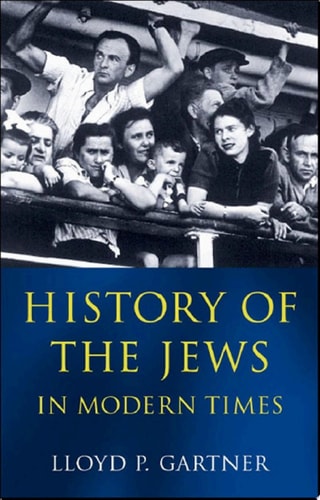
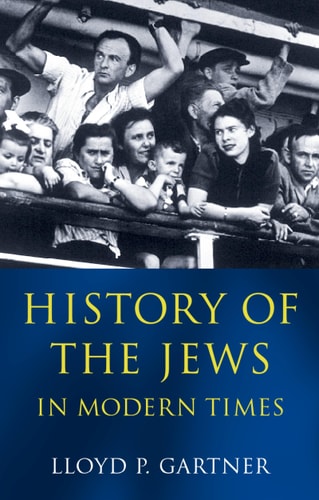
History of the Jews in Modern Times
0
0
As an Amazon Associate and affiliate partner, Menrva Books earns from qualifying purchases. Learn more
Author Description
Lloyd Gartner presents, in chronologically-arranged chapters, the story of the changing fortunes of the Jewish communities of the Old World (in Europe and the Middle East and beyond) and their gradual expansion into the New World of the Americas. The book starts in 1650, when there were no more than one and a quarter million Jews in the world (less than a sixth of the number at the start of the Christian era). Gartner leads us through the traditions, religious laws, communities and their interactions with their neighbours, through the Enlightenment, the French Revolution, and into Emancipation, the dark shadows of anti-Semitism, the impact of World War II, bringing us up to the twentieth century through Zionism, and the foundation of Israel. Throughout, the story is powerful and engrossing - enlivened by curious detail and vivid insights. Gartner, an expert guide and scholar on the subject, writing from within the Jewish community, remains objective and effective whilst being careful to introduce and explain Jewish terminology and Jewish institutions as they appear in the text. This is a superb introductory account - authoritative, in control, lively of the central threads in one of the greatest historical tapestries of modern times.
Menrva's Summary
THE THESIS
This work investigates the evolution and transformation of Jewish communities from the mid-17th century through the 20th century. Lloyd P. Gartner, a recognized scholar in the field of Jewish history, utilizes a chronological framework to analyze how these communities navigated shifting political landscapes, religious traditions, and social integration. The text argues that the modern Jewish experience is defined by a complex interplay between internal institutional preservation and external pressures from Enlightenment ideals, revolutionary movements, and global conflicts.
THE SCOPE MAP
What You Will Find
- A chronological survey of Jewish history from 1650 to the late 20th century.
- Analysis of the transition from Old World communities to the expansion into the Americas.
- Examination of key historical milestones including the Enlightenment, the French Revolution, and the rise of Zionism.
- Explanations of core Jewish terminology and institutional structures.
Scope Limits
- The text does not provide an exhaustive micro-history of every individual Jewish community.
- It does not focus on ancient or medieval history, beginning its scope specifically in 1650.
THE AUTHORITY PERSPECTIVE
Scholars and students frequently cite this work as a reliable and accessible introductory text for understanding the trajectory of modern Jewish history. Experts highlight the author's ability to maintain academic objectivity while providing necessary context for readers unfamiliar with specific religious or cultural institutions.
Page Count:
481
Publication Date:
2000-01-01
Publisher:
OUP Oxford
ISBN-10:
0191606723
ISBN-13:
9780191606724
History
Religion
Jewish History
Jewish Studies
Sociology
Modern History
Community Tags
Other Editions(4)


Similar Books