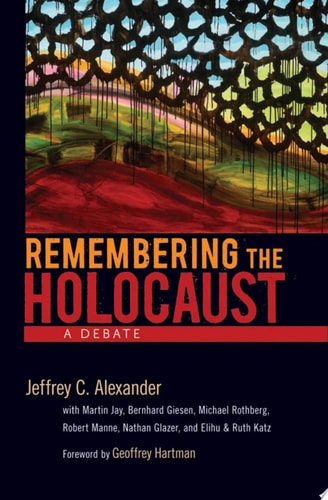
Remembering the Holocaust: A Debate
0
0
As an Amazon Associate and affiliate partner, Menrva Books earns from qualifying purchases. Learn more
Author Description
Remembering the Holocaust explains why the Holocaust has come to be considered the central event of the 20th century, and what this means. Presenting Jeffrey Alexander's controversial essay that, in the words of Geoffrey Hartman, has already become a classic in the Holocaust literature, and following up with challenging and equally provocative responses to it, this book offers a sweeping historical reconstruction of the Jewish mass murder as it evolved in the popular imagination of Western peoples, as well as an examination of its consequences. Alexander's inquiry points to a broad cultural transition that took place in Western societies after World War II: from confidence in moving past the most terrible of Nazi wartime atrocities to pessimism about the possibility for overcoming violence, ethnic conflict, and war. The Holocaust has become the central tragedy of modern times, an event which can no longer be overcome, but one that offers possibilities to extend its moral lessons beyond Jews to victims of other types of secular and religious strife. Following Alexander's controversial thesis is a series of responses by distinguished scholars in the humanities and social sciences--Martin Jay, Bernhard Giesen, Michael Rothberg, Robert Manne, Nathan Glazer, and Elihu & Ruth Katz--considering the implications of the universal moral relevance of the Holocaust. A final response from Alexander in a postscript focusing on the repercussions of the Holocaust in Israel concludes this forthright and engaging discussion. Remembering the Holocaust is an all-too-rare debate on our conception of the Holocaust, how it has evolved over the years, and the profound effects it will have on the way we envision the future.
Menrva's Summary
THE THESIS
This book investigates the cultural processes through which the Holocaust transitioned from a specific historical event into the central moral and symbolic tragedy of the 20th century. Jeffrey C. Alexander, a prominent sociologist, utilizes cultural theory to analyze the evolution of collective memory in Western societies. He argues that the post-war shift from optimism to a pervasive sense of historical pessimism is directly linked to the elevation of the Holocaust as a universalized moral touchstone. The text presents this argument through an initial essay followed by critical engagement from a diverse panel of scholars.
THE SCOPE MAP
What You Will Find
- A historical reconstruction of how the Holocaust entered the Western popular imagination.
- A theoretical framework for understanding collective memory and cultural trauma.
- A series of critical responses from scholars including Martin Jay, Michael Rothberg, and Nathan Glazer.
- A concluding postscript addressing the specific repercussions of Holocaust memory within Israel.
Scope Limits
- The text does not provide a comprehensive chronological history of the events of the Holocaust itself.
- It does not focus on primary archival research regarding the Nazi regime, but rather on the sociological reception of the event.
THE AUTHORITY PERSPECTIVE
Experts recognize this work as a significant contribution to the sociology of memory and cultural trauma studies. Readers frequently note the academic density of the prose and the value of the multi-perspective debate format for understanding the complexities of historical representation.
Page Count:
224
Publication Date:
2009-01-01
Publisher:
Oxford University Press
ISBN-10:
0190207639
ISBN-13:
9780190207632
History
Philosophy
Jewish Studies
Sociology
Jewish History
Jewish Holocaust
Ethics
Community Tags
Similar Books