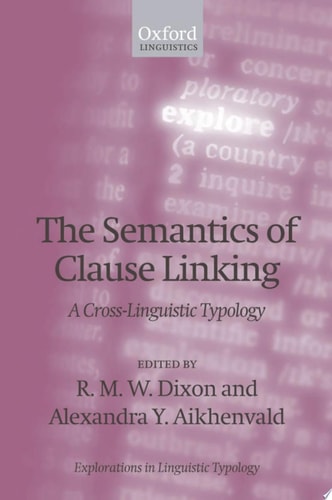
The Semantics of Clause Linking: A Cross-Linguistic Typology
0
0
As an Amazon Associate and affiliate partner, Menrva Books earns from qualifying purchases. Learn more
Author Description
This book is a cross-linguistic examination of the different grammatical means languages employ to represent a general set of semantic relations between clauses. The investigations focus on ways of combining clauses other than through relative and complement clause constructions. These span a number of types of semantic linking. Three, for example, describe varieties of consequence - cause, result, and purpose - which may be illustrated in English by, respectively: Because John has been studying German for years, he speaks it well; John has been studying German for years, thus he speaks it well; and John has been studying German for years, in order that he should speak it well. Syntactic descriptions of languages provide a grammatical analysis of clause types. The chapters in this book add the further dimension of semantics, generally in the form of focal and supporting clauses, the former referring to the central activity or state of the biclausal linking; and the latter to the clause attached to it. The supporting clause may set out the temporal milieu for the focal clause or specify a condition or presupposition for it or a preliminary statement of it, as in Although John has been studying German for years (the supporting clause), he does not speak it well (the focal clause). Professor Dixon's extensive opening discussion is followed by fourteen case studies of languages ranging from Korean and Kham to Iquito and Ojibwe. The book's concluding synthesis is provided by Professor Aikhenvald.
Menrva's Summary
THE THESIS
This volume investigates the diverse grammatical strategies languages utilize to encode semantic relationships between clauses, specifically excluding relative and complement constructions. Authors Alexandra Y. Aikhenvald and R. M. W. Dixon, both prominent figures in linguistic typology, utilize a comparative framework to analyze how languages distinguish between focal and supporting clauses. By examining various semantic links such as cause, result, and purpose, the authors argue that a semantic dimension is essential for a comprehensive understanding of biclausal structures across global language families.
THE SCOPE MAP
What You Will Find
- A theoretical framework for distinguishing focal and supporting clause functions
- Analysis of semantic relations including temporal, conditional, and causal linking
- Fourteen distinct case studies covering languages such as Korean, Kham, Iquito, and Ojibwe
Scope Limits
- Excludes detailed analysis of relative and complement clause constructions
- Focuses primarily on cross-linguistic typology rather than the prescriptive grammar of a single language
THE AUTHORITY PERSPECTIVE
Linguists and students of typology frequently cite this work as a foundational resource for understanding the intersection of syntax and semantics in clause combining. Experts note the high level of academic rigor and the breadth of the language samples provided, making it a standard reference for comparative linguistic research.
Page Count:
379
Publication Date:
2009-01-01
Publisher:
OUP Oxford
ISBN-10:
0191609951
ISBN-13:
9780191609954
English
Semantics
Academic
Grammar
Syntax
English & College Success
Linguistics
Typology