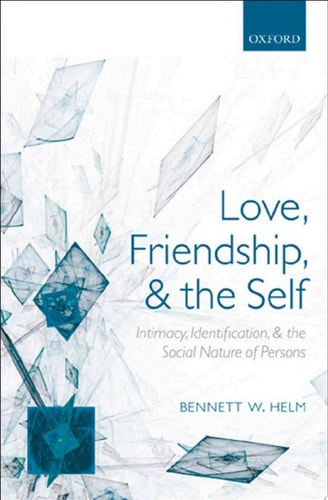
Love, Friendship, and the Self: Intimacy, Identification, and the Social Nature of Persons
0
0
As an Amazon Associate and affiliate partner, Menrva Books earns from qualifying purchases. Learn more
Author Description
Recent Western thought has consistently emphasized the individualistic strand in our understanding of persons at the expense of the social strand. Thus, it is generally thought that persons are self-determining and autonomous, where these are understood to be capacities we exercise most fully on our own, apart from others, whose influence on us tends to undermine that autonomy. Love, Friendship, and the Self argues that we must reject a strongly individualistic conception of persons if we are to make sense of significant interpersonal relationships and the importance they can have in our lives. It presents a new account of love as intimate identification and of friendship as a kind of plural agency, in each case grounding and analyzing these notions in terms of interpersonal emotions. At the center of this account is an analysis of how our emotional connectedness with others is essential to our very capacities for autonomy and self-determination: we are rational and autonomous only because of and through our inherently social nature. By focusing on the role that relationships of love and friendship have both in the initial formation of our selves and in the on-going development and maturation of adult persons, Helm significantly alters our understanding of persons and the kind of psychology we persons have as moral and social beings.
Menrva's Summary
THE THESIS
This book investigates the core question of how interpersonal relationships, specifically love and friendship, are foundational to the development of human autonomy and self-determination. Bennett W. Helm, a philosopher specializing in ethics and the philosophy of mind, challenges the prevailing Western individualistic paradigm. He argues that autonomy is not an isolated capacity but one that is inherently social, requiring emotional connectedness with others to function effectively.
THE SCOPE MAP
What You Will Find
- A philosophical framework defining love as intimate identification.
- An analysis of friendship conceptualized as a form of plural agency.
- An exploration of the role of interpersonal emotions in moral psychology.
- Theoretical arguments linking social connection to the maturation of the self.
Scope Limits
- The text does not provide empirical psychological data or clinical case studies.
- It does not focus on sociological or anthropological surveys of relationship structures.
THE AUTHORITY PERSPECTIVE
Experts in moral philosophy and the philosophy of mind recognize this work as a significant contribution to the debate on social ontology and the nature of the self. Readers frequently note the academic density of the prose, which requires a strong background in philosophical terminology to fully grasp the author's arguments.
Page Count:
333
Publication Date:
2010-01-01
Publisher:
OUP Oxford
ISBN-10:
0191609986
ISBN-13:
9780191609985
Philosophy
Psychology
Social Philosophy
Metaphysics
Identity Philosophical concept
Interpersonal Relationships
Ethics
Community Tags
Similar Books