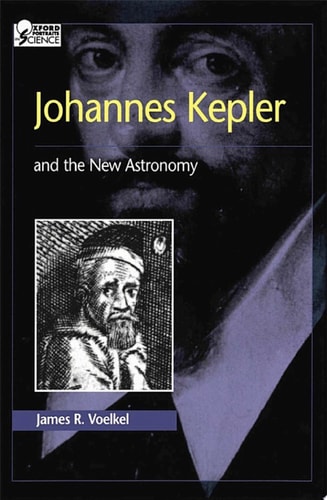
Johannes Kepler: And the New Astronomy
0
0
As an Amazon Associate and affiliate partner, Menrva Books earns from qualifying purchases. Learn more
Author Description
Johannes Kepler (1571-1630) is remembered, along with Copernicus and Galileo, as one of the greatest Renaissance astronomers. A gifted analytical thinker, he made major contributions to physics, astronomy, and mathematics. Kepler was trained as a theologian, yet did not hesitate to challenge church doctrine and prevailing scientific beliefs by supporting the theory of a Sun-centered solar system. As Imperial Mathematician to the Holy Roman Emperor, he analyzed the precise observations of the heavens that his predecessor, the great astronomer Tycho Brahe, had recorded. The book follows the ingenious scientist along the difficult pathway from raw data to his monumental discovery--the three Laws of Planetary Motion. Kepler also made fundamental contributions to optical theory, including a correct description of the function of the eye and a new and improved telescope design. His unique Rudolfine Tables, universal calculations of planetary motion, were unprecedented in their accuracy. James Voelkel vividly describes these scientific achievements, providing enough background in astronomy and geometry so even beginners can follow Kepler's thinking and enjoy this book. Equally captivating is his account of Kepler's tumultuous life, plagued by misery, disease, war, and fervent religious persecution. Oxford Portraits in Science is an ongoing series of scientific biographies for young adults. Written by top scholars and writers, each biography examines the personality of its subject as well as the thought process leading to his or her discoveries. These illustrated biographies combine accessible technical information with compelling personal stories to portray the scientists whose work has shaped our understanding of the natural world.
Menrva's Summary
THE THESIS
This biography investigates how Johannes Kepler synthesized theological training, mathematical rigor, and observational data to formulate the three Laws of Planetary Motion. James R. Voelkel, a scholar of the history of science, utilizes primary source records and historical context to reconstruct Kepler's intellectual development. The text argues that Kepler's contributions to physics and optics were not merely isolated discoveries but the result of a systematic challenge to prevailing scientific and religious dogmas of the Renaissance era.
THE SCOPE MAP
What You Will Find
- Analysis of the transition from geocentric models to the heliocentric system.
- Detailed explanations of the three Laws of Planetary Motion.
- Historical context regarding the Rudolfine Tables and the work of Tycho Brahe.
- Biographical accounts of Kepler's personal hardships, including religious persecution and the impact of the Thirty Years' War.
Scope Limits
- The text does not provide an exhaustive mathematical derivation of all Keplerian proofs.
- It does not cover the full history of post-Keplerian celestial mechanics beyond his immediate influence.
THE AUTHORITY PERSPECTIVE
Experts and educators frequently cite this volume as an accessible entry point for students interested in the history of science. Readers note that the prose successfully balances technical astronomical concepts with the personal narrative of Kepler's life.
Page Count:
146
Publication Date:
2001-01-01
Publisher:
Oxford University Press
ISBN-10:
0190287748
ISBN-13:
9780190287740
Science
Biography
Science History
English
Mathematics
English & College Success
Astronomy
Physics
Community Tags
Similar Books