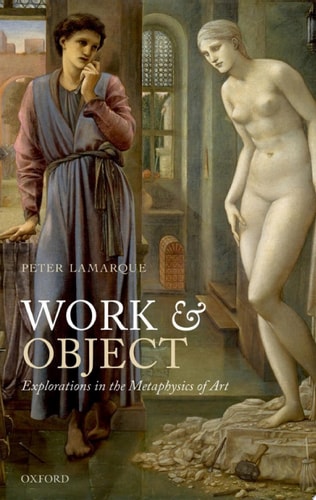
Work and Object: Explorations in the Metaphysics of Art
0
0
As an Amazon Associate and affiliate partner, Menrva Books earns from qualifying purchases. Learn more
Author Description
Work and Object is a study of fundamental questions in the metaphysics of art, notably how works relate to the materials that constitute them. Issues about the creation of works, what is essential and inessential to their identity, their distinct kinds of properties, including aesthetic properties, their amenability to interpretation, their style, the conditions under which they can go out of existence, and their relation to perceptually indistinguishable doubles (e.g. forgeries and parodies), are raised and debated. A core theme is that works like paintings, music, literature, sculpture, architecture, films, photographs, multi-media installations, and many more besides, have fundamental features in common, as cultural artefacts, in spite of enormous surface differences. It is their nature as distinct kinds of things, grounded in distinct ontological categories, that is the subject of this enquiry. Although much of the discussion is abstract, based in analytical metaphysics, there are numerous specific applications, including a study of Jean-Paul Sartre's novel La Nausée and recent conceptual art. Some surprising conclusions are derived, about the identity conditions of works and about the difference, often, between what a work seems to be and what it really is.
Menrva's Summary
THE THESIS
This book investigates the ontological status of artworks and the fundamental relationship between a work of art and the physical materials that constitute it. Peter Lamarque, a prominent philosopher of art, utilizes the framework of analytical metaphysics to examine how cultural artifacts maintain identity across various media. He argues that despite the surface-level differences between paintings, literature, and film, these works share common ontological categories that define their existence and persistence.
THE SCOPE MAP
What You Will Find
- Analysis of identity conditions for diverse art forms including sculpture, architecture, and multimedia installations
- Examination of the relationship between works and their perceptually indistinguishable counterparts like forgeries
- Application of metaphysical theory to specific examples such as Jean-Paul Sartre's La Nausée and contemporary conceptual art
Scope Limits
- The text does not provide a historical survey of art movements or a sociological analysis of art markets
- It does not focus on subjective emotional responses to art, prioritizing logical and ontological inquiry instead
THE AUTHORITY PERSPECTIVE
Experts in aesthetics and philosophy frequently cite this work as a rigorous contribution to the ontology of art. Readers often note the high level of academic density, making it most suitable for those with a background in analytical philosophy.
Page Count:
263
Publication Date:
2010-01-01
Publisher:
OUP Oxford
ISBN-10:
0191614661
ISBN-13:
9780191614668
Philosophy
Metaphysics
Ontology
Art Theory
Aesthetics
Arts philosophy
Community Tags
Similar Books