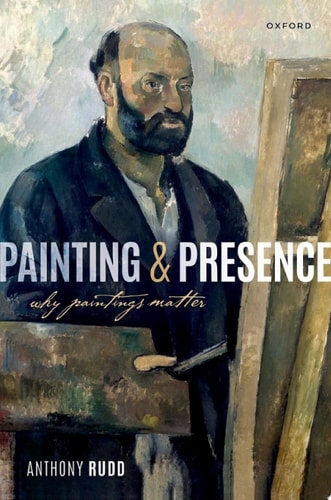
Painting and Presence: Why Paintings Matter
0
0
As an Amazon Associate and affiliate partner, Menrva Books earns from qualifying purchases. Learn more
Author Description
This book is concerned with why (or whether) paintings have value: why they might be worth creating and attending to. The author starts from the challenge expressed in Plato's critique of the arts generally, according to which they do not lead us to what is true and good, and may take us away from them. Rudd tries to show that this Platonic Challenge can be answered in its own terms: that painting is good because it does lead us to truth. What paintings can give us is a non-discursive "knowledge by acquaintance" in which the essence of the painting's subject-matter is made present to the viewer. Rudd traces this understanding of painting as ontologically revelatory from the theology of the Byzantine Icon to classical Chinese appreciations of landscape painting, to the work of Merleau-Ponty and other Phenomenologists inspired by European Modernist art. He argues that this account of painting as disclosing the essences of things can also take up what is right about expressive and formalist theories of painting; and that it can apply as much to abstract as to representational painting. But to disclose the reality of things can only be of value if the reality disclosed is itself of value; and in the concluding part of the book, Rudd argues that the value of painting can only be properly understood in the context of a wider metaphysics or theology in which value is understood, not as a human projection, but as a basic characteristic of reality as such.
Menrva's Summary
THE THESIS
This book investigates whether paintings possess intrinsic value and how they function as a medium for accessing truth. Anthony Rudd, a philosopher, utilizes a framework rooted in phenomenology and classical metaphysics to counter the Platonic critique that art distracts from reality. He argues that painting provides a unique form of non-discursive knowledge, revealing the essences of subjects through a direct acquaintance that transcends mere representation.
THE SCOPE MAP
What You Will Find
- Analysis of the Platonic Challenge regarding the truth-value of art
- Comparative study of Byzantine Icon theology and classical Chinese landscape aesthetics
- Application of Merleau-Ponty’s phenomenological theories to European Modernist art
- Integration of expressive and formalist art theories into an ontological framework
Scope Limits
- The text does not provide a historical survey of art movements outside of those relevant to the author's metaphysical argument
- The book does not offer practical techniques for painting or art creation
THE AUTHORITY PERSPECTIVE
Scholars and readers often note the philosophical density of the prose, which requires a background in aesthetic theory to fully grasp. Experts highlight this work as a significant contribution to the intersection of ontology and art criticism, particularly for its attempt to ground artistic value in a broader metaphysical context.
Page Count:
254
Publication Date:
2022-01-01
Publisher:
OUP Oxford
ISBN-10:
0192669125
ISBN-13:
9780192669124
Philosophy
Art History
Painting
Phenomenology
Art Theory
Metaphysics
Aesthetics
Community Tags
Similar Books