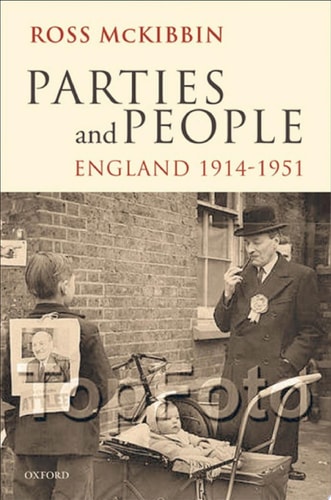
Parties and People: England 1914-1951
0
0
As an Amazon Associate and affiliate partner, Menrva Books earns from qualifying purchases. Learn more
Author Description
The 'sequel' to his best-selling Classes and Cultures, Ross McKibbin's latest book is a powerful reinterpretation of British politics in the first decades of universal suffrage. What did it mean to be a 'democratic society'? To what extent did voters make up their own minds on politics or allow elites to do it for them? Exploring the political culture of these extraordinary years, Parties and People shows that class became one of the principal determinants of political behaviour, although its influence was often surprisingly weak. McKibbin argues that the kind of democracy that emerged in Britain was far from inevitable-as much historical accident as design-and was in many ways highly flawed.
Menrva's Summary
THE THESIS
This book investigates the evolution of British political culture and the nature of democracy during the era of universal suffrage between 1914 and 1951. Ross McKibbin, a distinguished historian of modern Britain, utilizes a synthesis of electoral data, social history, and political analysis to challenge conventional narratives regarding the stability and inevitability of the British democratic system. He argues that the political landscape of the early twentieth century was shaped as much by historical contingency and structural flaws as it was by intentional design.
THE SCOPE MAP
What You Will Find
- Analysis of the relationship between class identity and political behavior.
- Examination of the influence of political elites versus voter autonomy.
- Evaluation of the structural development of the British parliamentary system.
- Historical assessment of the period spanning the First World War through the post-WWII era.
Scope Limits
- The text focuses primarily on the British domestic political experience and does not provide an exhaustive account of international diplomatic relations.
- It does not attempt to provide a comprehensive biography of individual political leaders, focusing instead on broader societal trends.
THE AUTHORITY PERSPECTIVE
Historians and political scientists frequently cite this work as a rigorous examination of the complexities inherent in the development of the British electorate. Readers often note the academic density of the prose, which provides a detailed and nuanced perspective on the limitations of twentieth-century democratic institutions.
Page Count:
220
Publication Date:
2010-01-01
Publisher:
OUP Oxford
ISBN-10:
0191614998
ISBN-13:
9780191614996
History
Sociology
20th Century
European History
British History
Community Tags
Similar Books