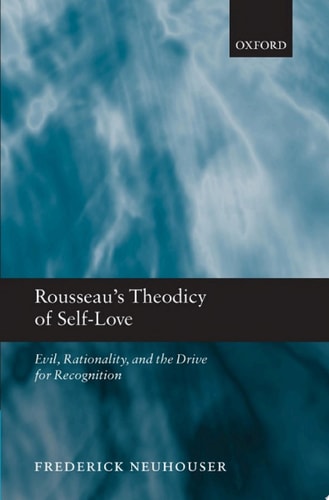
Rousseau's Theodicy of Self-Love: Evil, Rationality, and the Drive for Recognition
0
0
As an Amazon Associate and affiliate partner, Menrva Books earns from qualifying purchases. Learn more
Author Description
This book is the first comprehensive study of Rousseau's rich and complex theory of the type of self-love (amour propre ) that, for him, marks the central difference between humans and the beasts. Amour propre is the passion that drives human individuals to seek the esteem, approval, admiration, or love--the recognition --of their fellow beings. Neuhouser reconstructs Rousseau's understanding of what the drive for recognition is, why it is so problematic, and how its presence opens up far-reaching developmental possibilities for creatures that possess it. One of Rousseau's central theses is that amour propre in its corrupted, manifestations--pride or vanity--is the principal source of an array of evils so widespread that they can easily appear to be necessary features of the human condition: enslavement, conflict, vice, misery, and self-estrangement. Yet Rousseau also argues that solving these problems depends not on suppressing or overcoming the drive for recognition but on cultivating it so that it contributes positively to the achievement of freedom, peace, virtue, happiness, and unalienated selfhood. Indeed, Rousseau goes so far as to claim that, despite its many dangers, the need for recognition is a condition of nearly everything that makes human life valuable and that elevates it above mere animal existence: rationality, morality, freedom--subjectivity itself--would be impossible for humans if it were not for amour propre and the relations to others it impels us to establish.
Menrva's Summary
THE THESIS
This book investigates the dual nature of amour propre, or self-love, as both the primary source of human vice and the essential foundation for morality, freedom, and rationality. Frederick Neuhouser, a professor of philosophy, reconstructs Rousseau's complex psychological and social framework to explain how the human drive for recognition shapes individual development. By analyzing Rousseau's texts, Neuhouser argues that the corruption of self-love into vanity is not an inevitable human condition but a developmental outcome that can be redirected toward positive social and personal ends.
THE SCOPE MAP
What You Will Find
- A comprehensive reconstruction of Rousseau's theory of amour propre.
- Analysis of the relationship between social recognition and human subjectivity.
- Examination of the transition from corrupted vanity to virtuous self-love.
Scope Limits
- The text does not provide a general biography of Rousseau's life.
- It does not offer a broad survey of 18th-century political history beyond the scope of Rousseau's specific philosophical arguments.
THE AUTHORITY PERSPECTIVE
Scholars recognize this work as a definitive study on the psychological underpinnings of Rousseau's political philosophy. Readers frequently note the academic density of the prose, which serves as a rigorous resource for students of modern political thought.
Page Count:
308
Publication Date:
2010-01-01
Publisher:
OUP Oxford
ISBN-10:
0191615552
ISBN-13:
9780191615559
Philosophy
Ethics
Social Theory
History & Surveys
Political Philosophy
Philosophy French
Community Tags
Similar Books