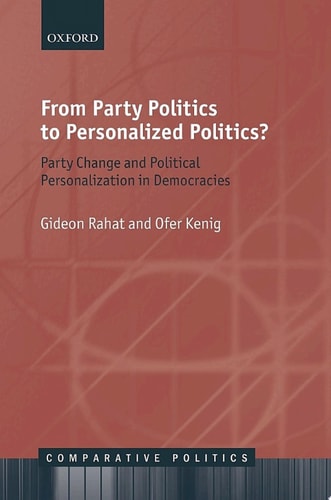
From Party Politics to Personalized Politics?: Party Change and Political Personalization in Democracies
0
0
As an Amazon Associate and affiliate partner, Menrva Books earns from qualifying purchases. Learn more
Author Description
What do Beppe Grillo, Silvio Berlusconi, Emmanuel Macron (and also Donald Trump) have in common? They are prime examples of the personalization of politics and the decline of political parties. This volume systematically examines these two prominent developments in contemporary democratic politics and the relationship between them. It presents a cross-national comparative comparison that covers around 50 years in 26 democracies through the use of more than 20 indicators. It offers the most comprehensive comparative cross-national estimation of the variance in the levels and patterns of party change and political personalization among countries to date, using existing works as well injecting fresh cross-national comparative data. In the case of party change, it offers an analysis that extends beyond the dichotomous debate of party decline versus party adaptation. In the matter of political personalization, the emphasis on variance helps in bridging between the high theoretical expectations and disappointing empirical findings. As for the theoretically sound linkage between the two phenomena, not only is this the first study to comprise a comprehensive cross-national examination, but it also proposes a more nuanced understanding of this relationship. Comparative Politics is a series for researchers, teachers, and students of political science that deals with contemporary government and politics. Global in scope, books in the series are characterised by a stress on comparative analysis and strong methodological rigour. The series is published in association with the European Consortium for Political Research. For more information visit: www.ecprnet.eu. The series is edited by Emilie van Haute, Professor of Political Science, Université libre de Bruxelles; Ferdinand Müller-Rommel, Director of the Center for the Study of Democracy, Leuphana University; and Susan Scarrow, John and Rebecca Moores Professor of Political Science, University of Houston.
Menrva's Summary
THE THESIS
This book investigates the relationship between the decline of traditional political parties and the rise of political personalization in contemporary democracies. Authors Gideon Rahat and Ofer Kenig utilize a rigorous comparative framework to analyze how these two trends interact across diverse political systems, moving beyond simple narratives of party decay to explore complex patterns of adaptation and individual-centered leadership.
THE SCOPE MAP
What You Will Find
- A longitudinal analysis covering 50 years of political data.
- A comparative study of 26 distinct democracies.
- A methodological framework utilizing over 20 specific indicators to measure party change and personalization.
Scope Limits
- The study does not cover non-democratic regimes or authoritarian political structures.
- The analysis focuses on systemic trends rather than individual biographies of the political figures mentioned.
THE AUTHORITY PERSPECTIVE
Experts recognize this work as a foundational comparative study that provides necessary empirical depth to the theoretical debate surrounding political personalization. Scholars frequently highlight the book's methodological rigor and its ability to bridge the gap between high-level political theory and observed electoral outcomes.
Page Count:
400
Publication Date:
2018-01-01
Publisher:
OUP Oxford
ISBN-10:
0192535439
ISBN-13:
9780192535436
Sociology
Comparative Politics
Government
Democracy
Community Tags
Similar Books


Reader Comments
Share Your Thoughts
No comments yet. Be the first to share your thoughts!