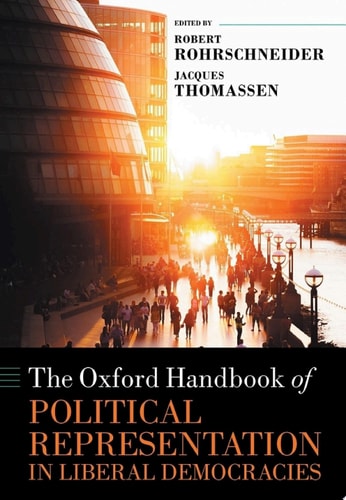
The Oxford Handbook of Political Representation in Liberal Democracies
0
0
As an Amazon Associate and affiliate partner, Menrva Books earns from qualifying purchases. Learn more
Author Description
The Handbook of Political Representation in Liberal Democracies offers a state-of-the-art assessment of the functioning of political representation in liberal democracies. In 34 chapters the world's leading scholars on the various aspects of political representation address eight broad themes: The concept and theories of political representation, its history and the main requisites for its development; elite orientations and behavior; descriptive representation; party government and representation; non-electoral forms of political participation and how they relate to political representation; the challenges to representative democracy originating from the growing importance of non-majoritarian institutions and social media; the rise of populism and its consequences for the functioning of representative democracy; the challenge caused by economic and political globlization: what does it mean for the functioning of political representation at the national leval and is it possible to develop institutions of representative democracy at a level above the state that meet the normative criteria of representative democracy and are supported by the people? The various chapters offer a comprehensive review of the literature on the various aspects of political representation. The main organizing principle of the Handbook is the chain of political representation, the chain connecting the interests and policy preferences of the people to public policy via political parties, parliament, and government. Most of the chapters assessing the functioning of the chain of political representation and its various links are based on original comparative political research. Comparative research on political representation and its various subfields has developed dramatically over the last decades so that even ten years ago a Handbook like this would have looked totally different.
Menrva's Summary
THE THESIS
How does the chain of political representation function within contemporary liberal democracies, and what are the primary challenges to its efficacy in an era of globalization and populism? Edited by Jacques Thomassen and Robert Rohrschneider, this volume compiles contributions from leading international scholars to evaluate the mechanisms connecting citizen preferences to public policy outcomes. The text utilizes comparative political research to analyze the structural integrity of representative institutions, including political parties, parliaments, and governmental bodies.
THE SCOPE MAP
What You Will Find
- Analysis of the conceptual history and theoretical foundations of political representation.
- Examination of elite behavior, descriptive representation, and party government dynamics.
- Investigation into the impact of non-majoritarian institutions, social media, and populism on democratic processes.
- Assessment of the influence of economic and political globalization on national-level representation.
- Comparative research methodologies applied to the chain of political representation.
Scope Limits
- The text focuses primarily on established liberal democracies rather than authoritarian or transitional regimes.
- It does not provide a prescriptive manual for political activism but rather an analytical overview of existing systems.
THE AUTHORITY PERSPECTIVE
Experts identify this volume as a comprehensive reference work that synthesizes decades of comparative political research. Readers frequently note the academic density of the prose, making it a standard resource for scholars and advanced students of political science.
Page Count:
736
Publication Date:
2020-01-01
Publisher:
OUP Oxford
ISBN-10:
0192558692
ISBN-13:
9780192558695
Government
Democracy
Political Theory
Comparative Politics
Public Policy
Community Tags
Other Editions(2)

Similar Books





Reader Comments
Share Your Thoughts
No comments yet. Be the first to share your thoughts!