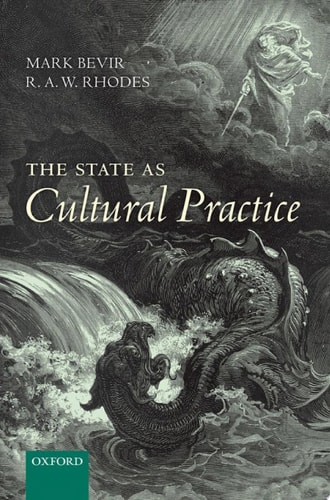
The State as Cultural Practice
0
0
As an Amazon Associate and affiliate partner, Menrva Books earns from qualifying purchases. Learn more
Author Description
The State as Cultural Practice offers a fully worked out account of the authors' distinctive interpretive approach to political science. It challenges the new institutionalism, probably the most significant present-day strand in both American and British political science. It moves away from such notions as 'bringing the state back in', 'path dependency' and modernist empiricism. Instead, Bevir and Rhodes argue for an anti-foundational analysis, ethnographic and historical methods, and a decentred approach that rejects any essentialist definition of the state and espouses the idea of politics as cultural practice. The book has three aims: · to develop an anti-foundational theory of the state · to develop a new research agenda around the topics of rule, rationalities, and resistance · by exploring empirical shifts and debates about the changing nature of the state to show how anti-foundational theory leads us to see them differently. Bevir and Rhodes argue for the idea of 'the stateless state' or the state as meaning-in-action. So, the state is neither monolithic nor a causal agent. It consists solely of the contingent actions of specific individuals; of diverse beliefs about the public sphere, about authority and power, which are constructed differently in contending traditions. Continuity and change are products of people inheriting traditions and modifying them in response to dilemmas. A decentred approach explores the limits to the state and seeks to develop a more diverse view of state authority and its exercise. In short, political scientists need to bring people back in to the study of the state.
Menrva's Summary
THE THESIS
This book investigates how political science can move beyond modernist empiricism and institutionalism by reconceptualizing the state as a cultural practice rather than a monolithic entity. Mark Bevir and R. A. W. Rhodes, both established scholars in political theory and governance, utilize an anti-foundationalist framework to argue that the state is constructed through the contingent actions and beliefs of individuals. They propose a decentred approach that prioritizes ethnographic and historical methods to understand how traditions and dilemmas shape political authority.
THE SCOPE MAP
What You Will Find
- An anti-foundational theory of the state based on meaning-in-action.
- A research agenda focused on rule, rationalities, and resistance.
- Analysis of the state as a product of individual beliefs and traditions.
Scope Limits
- The text does not provide a traditional institutionalist analysis of state structures.
- It avoids essentialist definitions of the state as a causal agent.
THE AUTHORITY PERSPECTIVE
Scholars in political science frequently cite this work as a significant critique of new institutionalism and a foundational text for interpretive political analysis. Readers often note the academic density of the prose, which requires a strong background in political theory to fully engage with the authors' arguments.
Page Count:
259
Publication Date:
2010-01-01
Publisher:
OUP Oxford
ISBN-10:
0191614807
ISBN-13:
9780191614804
Public Administration
Political Theory
Sociology
Governance