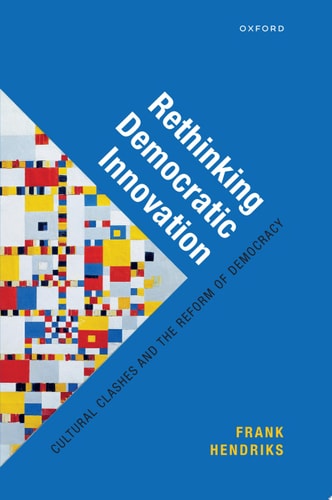
Rethinking Democratic Innovation: Cultural Clashes and the Reform of Democracy
0
0
As an Amazon Associate and affiliate partner, Menrva Books earns from qualifying purchases. Learn more
Author Description
Rethinking Democratic Innovation takes a fresh look at diverging visions of improving democratic governance and asks whether these existing tensions could be made productive. Could different visions of democratic revitalisation complement and correct each other in ways that are good for democracy? Is it conceivable that combined approaches address a larger part of the democratic challenge, while isolated approaches, centralizing deliberative or plebiscitary democracy, are confined to more limited areas of concern? This book ultimately provides an affirmative answer, outlining the scope for hybrid democratic innovations that thrive on exploiting, not eliminating, tensions between diverging visions of improved democracy.Supplementing democratic theory with a cultural perspective, this book contributes to a deeper understanding of plans and methods geared toward improving democratic governance. Revisiting Mary Douglas's seminal take on culture as pollution reduction, processes of democratic innovation are understood as instances of cultural cleaning in public governance.The book recognizes that democratic cleaning will never be finished but can be done in ways that are more productive. Reflecting on varieties of hybrid democratic innovation - deliberative referendums, participatory budgeting-new style, and more - the author posits that more versatile, connective, and embedded innovations stand a better chance of high performance on a broader spectrum than democratic innovations falling short of these qualities.
Menrva's Summary
THE THESIS
Can the inherent tensions between competing visions of democratic reform be synthesized into productive, hybrid models of governance? Prof. Frank Hendriks, a scholar of public administration and democratic theory, investigates how divergent approaches to democratic revitalization—such as deliberative and plebiscitary methods—often clash due to underlying cultural differences. By applying Mary Douglas’s cultural theory to public governance, Hendriks argues that democratic innovation functions as a form of 'cultural cleaning' and proposes that hybrid models, which embrace rather than eliminate these tensions, offer a more robust framework for modern governance.
THE SCOPE MAP
What You Will Find
- A theoretical framework integrating cultural theory with democratic reform strategies.
- Analysis of specific hybrid models including deliberative referendums and participatory budgeting.
- A comparative assessment of how different democratic visions address governance challenges.
Scope Limits
- The text does not provide a prescriptive manual for implementing specific local policies.
- It does not offer an exhaustive historical account of every democratic reform movement in the 21st century.
THE AUTHORITY PERSPECTIVE
Scholars in political science frequently note the academic density of the prose and the sophisticated application of cultural theory to administrative reform. Experts highlight this as a significant contribution to the literature on democratic innovation, particularly for its focus on the necessity of hybridity in complex political systems.
Page Count:
288
Publication Date:
2023-01-01
Publisher:
Oxford University Press
ISBN-10:
0192848291
ISBN-13:
9780192848291
Public Policy
Democracy
Governance
Political Theory
Sociology
Community Tags
Similar Books