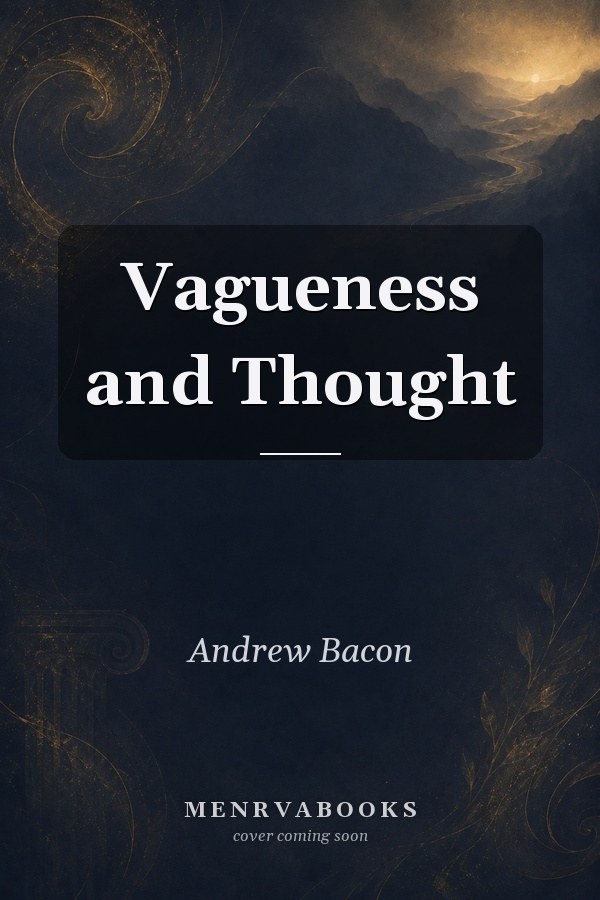
Vagueness and Thought
0
0
As an Amazon Associate and affiliate partner, Menrva Books earns from qualifying purchases. Learn more
Author Description
Vagueness is the study of concepts that admit borderline cases: the property of being bald is vague because there are people who are neither definitely bald, nor definitely not bald. The epistemology of vagueness concerns the sorts of attitudes we ought to have towards propositions we know to be borderline. Is it possible to discover whether a borderline bald man is bald? Could two people with access to the same facts reasonably disagree about whether he is bald? Does it matter, when making practical decisions, whether he is bald? By drawing on such considerations, Andrew Bacon develops a novel theory of vagueness in which vagueness is fundamentally a property of propositions, and is explicated in terms of its role in thought. On this theory, language plays little role in explaining the central puzzles of vagueness. Part I of the book outlines some of the central questions regarding the logic and epistemology of vagueness, and criticizes some extant approaches to them. Part II concerns issues in the epistemology of vagueness, touching on the ramifications of vague thoughts on the study of evidence, ignorance, desire, probability theory, and decision theory. By examining the effects of vague information on one's beliefs about the precise, a positive theory of vagueness is proposed. Part III concerns the logic of vagueness, including the interaction between vagueness and modality, vague identity, and the paradoxes of higher-order vagueness. Bacon suggests that some familiar philosophical notions -- including the concept of a fundamental proposition, a possible world and a precisification -- need to be revised.
Menrva's Summary
THE THESIS
How can the phenomenon of vagueness be understood as a fundamental property of propositions rather than a linguistic feature? Andrew Bacon, a philosopher specializing in logic and metaphysics, challenges traditional linguistic-based theories of vagueness. He argues that vagueness is best explicated through its role in human thought, utilizing formal logic and decision theory to construct a new framework that addresses borderline cases and the nature of belief.
THE SCOPE MAP
What You Will Find
- A formal theory of vagueness centered on propositional properties.
- Analysis of the intersection between vagueness and probability, evidence, and desire.
- Revisions to traditional philosophical concepts such as possible worlds and precisification.
Scope Limits
- The text does not focus on sociolinguistic or purely semantic approaches to vagueness.
- It assumes a high level of familiarity with formal logic and analytic philosophy.
THE AUTHORITY PERSPECTIVE
Experts in analytic philosophy recognize this work as a significant contribution to the ongoing debate regarding the logic of borderline cases. Readers frequently note the high degree of technical density and the rigorous formal methodology employed throughout the text.
Page Count:
368
Publication Date:
2018-01-01
Publisher:
OUP Oxford
ISBN-10:
0191020036
ISBN-13:
9780191020032
Philosophy
Academic
Epistemology
Metaphysics
Language
Logic
Community Tags
Other Editions(3)

Similar Books