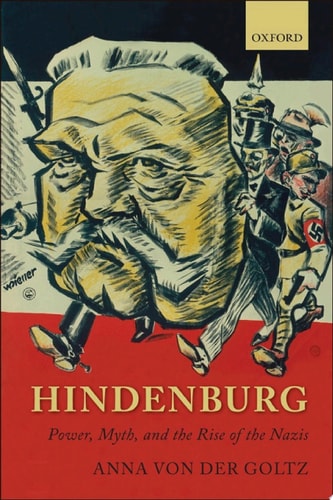
Hindenburg: Power, Myth, and the Rise of the Nazis
0
0
As an Amazon Associate and affiliate partner, Menrva Books earns from qualifying purchases. Learn more
Author Description
Hindenburg reveals how a previously little-known general, whose career to normal retirement age had provided no real foretaste of his heroic status, became a national icon and living myth in Germany after the First World War, capturing the imagination of millions. In a period characterized by rupture and fragmentation, the legend surrounding Paul von Hindenburg brought together a broad coalition of Germans and became one of the most potent forces in Weimar politics. Charting the origins of the myth, from Hindenburg's decisive victory at the Battle of Tannenberg in 1914 to his death in Nazi Germany and beyond, Anna von der Goltz explains why the presence of Hindenburg's name on the ballot mesmerized an overwhelming number of voters in the presidential elections of 1925. His myth, an ever-evolving phenomenon, increasingly transcended the dividing lines of interwar politics, which helped him secure re-election by left-wing and moderate voters. Indeed, the only two times in German history that the people could elect their head of state directly and secretly, they chose this national icon. Hindenburg even managed to defeat Adolf Hitler in 1932, making him the Nazi leader's final arbiter; it was he who made the final and fateful decision to appoint Hitler as Chancellor in January 1933.
Menrva's Summary
THE THESIS
This work investigates how Paul von Hindenburg transitioned from an obscure general to a pervasive national icon and political myth that shaped the trajectory of the Weimar Republic. Anna von der Goltz, a scholar of modern German history, utilizes archival research and political analysis to examine the construction of the Hindenburg legend. She argues that this manufactured status was not merely a product of military success but a deliberate political tool that bridged ideological divides and ultimately facilitated the rise of the Nazi regime.
THE SCOPE MAP
What You Will Find
- Analysis of the Battle of Tannenberg and its role in myth-making
- Examination of Weimar-era electoral politics and voter behavior
- Investigation into the intersection of military prestige and civilian governance
- Primary source analysis of political propaganda and public perception
Scope Limits
- The text does not provide a comprehensive military biography of Hindenburg's early career
- It does not focus on the internal mechanics of the Nazi party beyond Hindenburg's interaction with Hitler
THE AUTHORITY PERSPECTIVE
Scholars recognize this monograph as a rigorous examination of the intersection between political myth-making and institutional collapse in interwar Germany. Readers frequently note the academic density of the prose, which provides a detailed look at the complexities of Weimar political culture.
Page Count:
342
Publication Date:
2009-01-01
Publisher:
OUP Oxford
ISBN-10:
0191610046
ISBN-13:
9780191610042
History
Biography
Military History
German history
Germany biography
European History
Community Tags
Similar Books