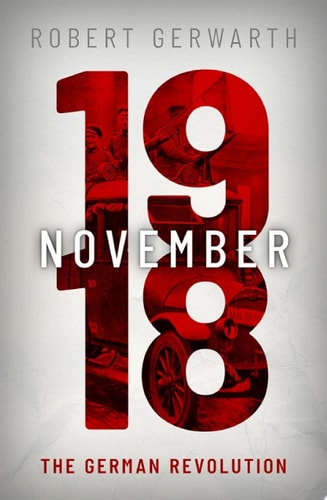
November 1918: The German Revolution
0
0
As an Amazon Associate and affiliate partner, Menrva Books earns from qualifying purchases. Learn more
Author Description
The German Revolution of November 1918 is nowadays largely forgotten outside Germany. It is generally regarded as a failure even by those who have heard of it, a missed opportunity which paved the way for the rise of the Nazis and the catastrophe to come. Robert Gerwarth argues here that to view the German Revolution in this way is a serious misjudgement. Not only did it bring down the authoritarian monarchy of the Hohenzollern, it also brought into being the first ever German democracy in an amazingly bloodless way. Focusing on the dramatic events between the last months of the First World War in 1918 and Hitler's Munich Putsch of 1923, Robert Gerwarth illuminates the fundamental and deep-seated ways in which the November Revolution changed Germany. In doing so, he reminds us that, while it is easy with the benefit of hindsight to write off the 1918 Revolution as a 'failure', this failure was not somehow pre-ordained. In 1918, the fate of the German Revolution remained very much an open book.
Menrva's Summary
THE THESIS
Robert Gerwarth investigates whether the German Revolution of 1918 was an inevitable failure or a significant, viable democratic transition that has been unfairly maligned by historical hindsight.
Gerwarth, a professor of modern history, utilizes primary source accounts and political analysis to challenge the prevailing narrative that the 1918 revolution was merely a precursor to the rise of the Nazi party. He argues that the collapse of the Hohenzollern monarchy and the subsequent establishment of a democratic framework represented a genuine, non-predetermined attempt at political modernization. By examining the period between 1918 and the 1923 Munich Putsch, the author provides a corrective lens through which to view the stability and potential of the early Weimar Republic.
THE SCOPE MAP
What You Will Find
- Analysis of the collapse of the German monarchy in 1918.
- Examination of the political transition from imperial rule to the Weimar Republic.
- Evaluation of the period leading up to the 1923 Munich Putsch.
- Assessment of the democratic potential within post-war German society.
Scope Limits
- The text does not provide a comprehensive military history of the First World War itself.
- It does not focus on the long-term cultural developments of the Weimar Republic beyond the immediate political context.
THE AUTHORITY PERSPECTIVE
Historians and scholars of European history frequently cite this work as a necessary re-evaluation of a pivotal, often misunderstood moment in 20th-century politics. Readers often note that the prose is accessible yet rigorous, making it a valuable resource for both academic study and general historical interest.
Page Count:
355
Publication Date:
2020-01-01
Publisher:
OUP Oxford
ISBN-10:
0192606336
ISBN-13:
9780192606334
History
Military History
German history
20th Century
European History
Germany history