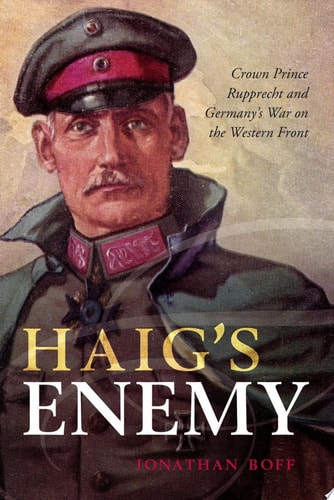
Haig's Enemy
0
0
As an Amazon Associate and affiliate partner, Menrva Books earns from qualifying purchases. Learn more
Author Description
During The First World War, The British Army's Most Consistent German Opponent Was Crown Prince Rupprecht Of Bavaria. Commanding More Than A Million Men As A General, And Then Field Marshal, In The Imperial German Army, He Held Off The Attacks Of The British Expeditionary Force Under Sir John French And Then Sir Douglas Haig For Four Long Years. But Rupprecht Was To Lose Not Only The War, But His Son And His Throne. In Haig's Enemy, Jonathan Boff Explores The Tragic Tale Of Rupprecht's War — The Story Of A Man Caught Under The Wheels Of Modern Industrial Warfare. Providing A Fresh Viewpoint On The History Of The Western Front, Boff Draws On Extensive Research In The German Archives To Offer A History Of The First World War From The Other Side Of The Barbed Wire. He Revises Conventional Explanations Of Why The Germans Lost With An In-depth Analysis Of The Nature Of Command, And Of The Institutional Development Of The British, French, And German Armies As Modern Warfare Was Born. Using Rupprecht's Own Diaries And Letters, Many Of Them Never Before Published, Haig's Enemy Views The Great War Through The Eyes Of One Of Germany's Leading Generals, Shedding New Light On Many Of The Controversies Of The Western Front. The Picture Which Emerges Is Far Removed From The Sterile Stalemate Of Myth. Instead, Boff Re-draws The Western Front As A Highly Dynamic Battlespace, Both Physical And Intellectual, Where Three Armies Struggled Not Only To Out-fight, But Also To Out-think, Their Enemy. The Consequences Of Falling Behind In The Race To Adapt Would Be More Terrible Than Ever Imagined.
Menrva's Summary
THE THESIS
This book investigates how Crown Prince Rupprecht of Bavaria, as a primary German commander, shaped the strategic and operational reality of the Western Front during the First World War. Jonathan Boff, a military historian, utilizes previously unpublished diaries and letters from Rupprecht alongside extensive German archival research to challenge traditional narratives of the conflict. The author argues that the war was not a static stalemate but a dynamic, intellectual, and industrial struggle where the ability to adapt institutional command structures determined the outcome.
THE SCOPE MAP
What You Will Find
- Analysis of the command structures of the British, French, and German armies.
- Primary source material from Crown Prince Rupprecht’s personal correspondence and diaries.
- Examination of the institutional development of modern industrial warfare.
Scope Limits
- The text focuses primarily on the Western Front and the German perspective under Rupprecht’s command.
- It does not provide a comprehensive global history of the First World War outside of the specific operational theaters managed by Rupprecht.
THE AUTHORITY PERSPECTIVE
Historians and military scholars frequently cite this work for its rigorous use of German archival sources to balance the traditionally British-centric view of the Western Front. Readers often note the academic density of the prose, which provides a sophisticated analysis of command-level decision-making during the conflict.
Page Count:
416
Publication Date:
2018-01-01
Publisher:
Oxford University Press
ISBN-10:
0191649295
ISBN-13:
9780191649295
Biography
History
World War
German history
Military History
European History
Community Tags
Similar Books