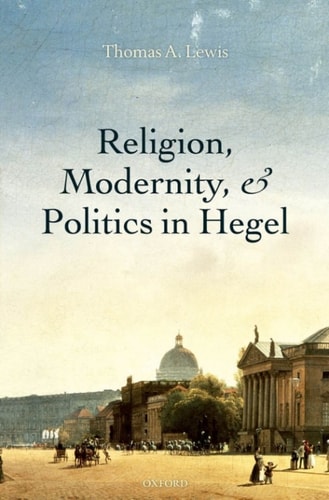
Religion, Modernity, and Politics in Hegel
0
0
As an Amazon Associate and affiliate partner, Menrva Books earns from qualifying purchases. Learn more
Author Description
Religion, Modernity, and Politics in Hegel analyzes Hegel's philosophy of religion and develops its significance for ongoing debates about the relation between religion and politics as well as the history of the conceptualization of religion. One of the most vital currents in contemporary Hegel scholarship argues that Hegel radicalizes, rather than reneges upon, Kant's critique of metaphysics. Critics have claimed that this new scholarship cannot account for Hegel's treatment of religion. Addressing an important lacuna in the scholarship, Lewis argues that reading Hegel's philosophy of religion in relation to these non-traditional interpretations of his intellectual project as a whole generates a new understanding of Hegel as well as a new perspective on religion, politics, and modernity. In relation to the conceptualization of religion, Hegel's complex and multi-faceted account of religion reconciles common contrasts, presenting religion as both personal and social, both emotional and cognitive, both theoretical and practical. In relation to politics, it is public without being theocratic and gives a decisive importance to individual conscience. Attending closely to Hegel's social, political, and intellectual context, the book begins with Hegel's early concerns with a modern civil religion in the tumultuous 1790s. After analyzing Hegel's crucial engagement with post-Kantian idealism, Lewis elaborates Hegel's mature philosophy of religion as presented in his Berlin Lectures on the Philosophy of Religion. This unique engagement between Hegel and the contemporary study of religion thus advances the non-traditionalist interpretation of Hegel's project as a whole and inspires a promising conception of religion that challenges those that have dominated both public discourse and religious studies scholarship.
Menrva's Summary
THE THESIS
How does Hegel's philosophy of religion reconcile the tensions between individual conscience and social order within the framework of modern political life? Thomas A. Lewis, a scholar of religious studies and philosophy, examines Hegel's intellectual project to bridge the gap between Kantian metaphysics and contemporary political theory. By analyzing Hegel's development from his early 1790s writings to his mature Berlin lectures, Lewis argues that Hegel offers a sophisticated model of religion that is simultaneously personal, cognitive, and public without succumbing to theocratic tendencies.
THE SCOPE MAP
What You Will Find
- An analysis of Hegel's engagement with post-Kantian idealism and the critique of metaphysics.
- A detailed examination of the Berlin Lectures on the Philosophy of Religion.
- A historical contextualization of Hegel's concerns regarding civil religion in the 1790s.
- A framework for understanding religion as both an emotional and practical social force.
Scope Limits
- The text does not provide a general introduction to Hegelian philosophy for lay readers.
- It does not cover the entirety of Hegel's political philosophy outside of its intersection with religious thought.
THE AUTHORITY PERSPECTIVE
Scholars identify this work as a significant intervention in the debate regarding non-traditional interpretations of Hegel's project. Readers frequently note the academic density of the prose, which is intended for specialists in philosophy and religious studies.
Page Count:
320
Publication Date:
2011-01-01
Publisher:
Oxford University Press
ISBN-10:
0191618764
ISBN-13:
9780191618765
Religion
Philosophy
Philosophy German
Modernity
Philosophy & Religion
Intellectual History
Community Tags
Other Editions(3)
Similar Books





Reader Comments
Share Your Thoughts
No comments yet. Be the first to share your thoughts!