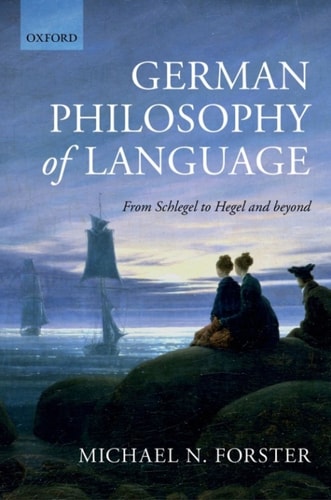
German Philosophy of Language: From Schlegel to Hegel and Beyond
0
0
As an Amazon Associate and affiliate partner, Menrva Books earns from qualifying purchases. Learn more
Author Description
Michael Forster here presents a ground-breaking study of German philosophy of language in the nineteenth century (and beyond). His previous book, After Herder, showed that the eighteenth-century philosopher J.G. Herder played the fundamental role in founding modern philosophy of language, including new theories of interpretation ('hermeneutics') and translation, as well as in establishing such whole new disciplines concerned with language as anthropology and linguistics. This new volume reveals that Herder's ideas continued to have a profound impact on such important nineteenth-century thinkers as Friedrich Schlegel (the leading German Romantic), Wilhelm von Humboldt (a founder of linguistics), and G.W.F. Hegel (the leading German Idealist). Forster shows that the most valuable ideas about language in this tradition were continuous with Herder's, whereas deviations from the latter that occurred tended to be inferior. This book not only sets the historical record straight but also champions the Herderian tradition for its philosophical depth and breadth.
Menrva's Summary
THE THESIS
This book investigates the historical development and philosophical continuity of German language theory from the influence of J.G. Herder through the nineteenth century. Michael N. Forster, a scholar of German philosophy, utilizes primary source analysis to argue that Herder established the foundational framework for modern linguistics and hermeneutics. The text demonstrates how subsequent thinkers, including Schlegel, Humboldt, and Hegel, maintained or deviated from these core Herderian principles.
THE SCOPE MAP
What You Will Find
- Historical analysis of the evolution of linguistic theory in Germany.
- Comparative study of Herder, Schlegel, Humboldt, and Hegel.
- Examination of the origins of modern anthropology and linguistics.
Scope Limits
- The text focuses primarily on the German tradition and does not provide a comprehensive global history of language philosophy.
- It does not attempt to cover twentieth-century analytical philosophy of language in detail.
THE AUTHORITY PERSPECTIVE
Scholars recognize this work as a significant contribution to the history of ideas, particularly for its rigorous defense of the Herderian tradition. Readers frequently note the academic density of the prose, which requires a strong background in German Idealism and Romanticism to fully appreciate the arguments presented.
Page Count:
350
Publication Date:
2011-01-01
Publisher:
Oxford University Press
ISBN-10:
0191619248
ISBN-13:
9780191619243
Philosophy
History & Surveys
Philosophy history
Hermeneutics
German Philosophy
Philosophy German
Linguistics
Community Tags
Similar Books