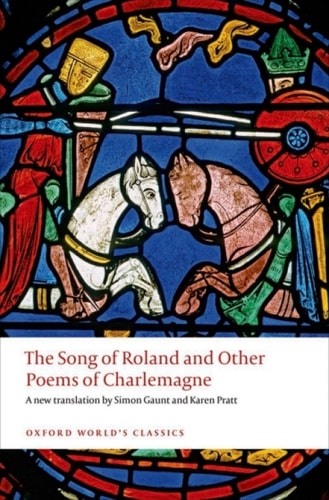
The Song of Roland and Other Poems of Charlemagne
0
0
As an Amazon Associate and affiliate partner, Menrva Books earns from qualifying purchases. Learn more
Author Description
Charles the king, our emperor great, Has been a full seven years in Spain. As far as the sea he conquered this haughty land. Not a single castle remains standing in his path Charlemagne (768-814) was crowned Holy Roman Emperor in 800 and presided over a huge empire. He frequently appears in literature as a great warlord and pious crusading figure. In 778, the rearguard of Charlemagne's retreating army was ambushed and defeated at the battle of Roncevaux. This became the inspiration for songs and poems celebrating deeds of valour in the face of overwhelming odds, through the character of Charlemagne's nephew (the imaginary) Roland. The Song of Roland is the most stirring and moving epic poem of the European Middle Ages, offering a particularly heady mixture of history, legend, and poetry. Presented here in a lively and idiomatic new translation, the Song of Roland offers fascinating insights into medieval ideas about heroism, manhood, religion, race, and nationhood which were foundational for modern European culture. The Song of Roland is accompanied here by two other medieval French epics about Charlemagne, both of which show him to be a far more equivocal figure than that portrayed by the Roland: the Occitan Daurel and Beton, in which he is a corrupt and avaricious monarch; and the Journey of Charlemagne to Jerusalem and Constantinople, which gives the heroes of the Roland a comic makeover.
Menrva's Summary
THE PULSE
The betrayal of Charlemagne's rearguard at the Battle of Roncevaux serves as the catalyst for a legendary struggle defined by honor, religious duty, and the tragic sacrifice of the knight Roland.
The narrative centers on the conflict between the Frankish forces and the Saracen armies, with Roland serving as the primary figure of chivalric virtue. His objective is to defend the rearguard against overwhelming odds, facing opposition from both external enemies and internal treachery. The text operates within the framework of the medieval chanson de geste, utilizing elevated, rhythmic language to emphasize the gravity of the combat and the moral stakes of the conflict. The world is governed by strict codes of feudal loyalty and divine mandate, where the physical landscape of Spain becomes a stage for the collision of empires and ideologies.
INSIDE THE PAGES
- Use of the chanson de geste verse form
- Exploration of the tension between historical reality and legendary myth
- Depiction of the knightly code of conduct
- Contrast between the heroic Roland and the flawed Charlemagne
- Inclusion of multiple epic perspectives on the Carolingian cycle
- Examination of medieval concepts of race and religion
- Integration of both tragic and comic narrative tones
- Scholarly translation providing context for medieval cultural values
THE COLLECTIVE ECHO
Discussion often centers on the stark contrast between the idealized heroism of the primary poem and the more cynical or humorous depictions of the monarch in the accompanying texts. Readers frequently highlight the accessibility of this translation, noting that it maintains the rhythmic intensity of the original while remaining readable for modern audiences. Critics emphasize the value of the collection in demonstrating how the figure of Charlemagne was reshaped by different medieval authors to suit varying political and social agendas. The work is widely regarded as a vital resource for understanding the foundational myths of European identity and the evolution of epic storytelling. Scholars often point to the inclusion of the lesser-known epics as a significant factor in providing a balanced view of the Carolingian literary tradition.
Page Count:
272
Publication Date:
2016-01-01
Publisher:
OUP Oxford
ISBN-10:
0191628190
ISBN-13:
9780191628191
Classics
Poetry
Epic Poetry
French literature
European
Medieval
European History