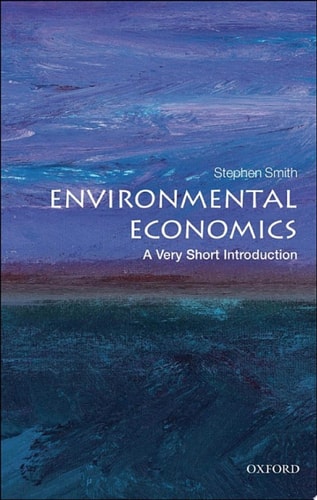
Environmental Economics: A Very Short Introduction
0
0
As an Amazon Associate and affiliate partner, Menrva Books earns from qualifying purchases. Learn more
Author Description
If environmental protection is costly, how much should we spend on pollution control? Is it worth reducing pollution to zero, or should we accept some level of pollution because of the economic benefits associated with it? How can we assess the benefits that people get from a less-polluted atmosphere? In broad terms, environmental economics looks at how economic activity and policy affect the environment in which we live. Some production generates pollution, such as power station emissions causing acid rain and contributing to global warming, but household consumption decisions also affect the environment, where more consumption can mean more waste sent to polluting incinerators. However, pollution is not an inevitable consequence of economic activity - environmental policies can require polluting firms to clean up their emissions, and can encourage people to change their behaviour, through environmental taxes on polluting goods, for example. Generally, though, these measures will involve some costs, such as installing pollution control equipment. So there's a trade-off: a cleaner environment, but economic costs. In recent years, many economists have argued for greater use of incentive in the form of pollution charges and emissions trading rather than more traditional direct regulation of polluters. In this Very Short Introduction, Stephen Smith discusses environmental issues including pollution control, reducing environmental damage, and global climate change policies, answering questions about how we should balance environmental and economic considerations, and what form government policies should take. Including many illustrative case studies and examples he shows that this is an exciting field of economics, and one that is at the heart of many public debates and controversies. ABOUT THE SERIES: The Very Short Introductions series from Oxford University Press contains hundreds of titles in almost every subject area. These pocket-sized books are the perfect way to
Menrva's Summary
THE THESIS
This book investigates the fundamental tension between economic growth and environmental preservation, questioning how societies can effectively balance the costs of pollution control against the benefits of industrial activity. Stephen J. Smith, a professor of economics, utilizes standard economic theory and policy analysis to examine how market mechanisms and government interventions can mitigate environmental degradation. The text provides a framework for understanding how taxes, emissions trading, and direct regulation function as tools to align private economic behavior with public environmental goals.
THE SCOPE MAP
What You Will Find
- Analysis of market-based instruments like pollution charges and emissions trading systems.
- Examination of the trade-offs between economic consumption and waste production.
- Case studies illustrating the application of environmental policy in real-world scenarios.
Scope Limits
- The text does not provide an exhaustive technical manual for environmental engineering or specific legislative drafting.
- It does not cover the entirety of global environmental law, focusing instead on the economic principles underlying policy decisions.
THE AUTHORITY PERSPECTIVE
Experts and academics recognize this work as a concise, accessible entry point for students and laypeople interested in the intersection of market dynamics and ecological health. Readers frequently note the clarity of the prose, which manages to distill complex economic concepts into a digestible format without sacrificing analytical rigor.
Page Count:
151
Publication Date:
2011-01-01
Publisher:
OUP Oxford
ISBN-10:
0191620297
ISBN-13:
9780191620294
Economics
Non-Fiction
Sustainability
Public Policy
Community Tags
Other Editions(2)
Similar Books


Reader Comments
Share Your Thoughts
No comments yet. Be the first to share your thoughts!