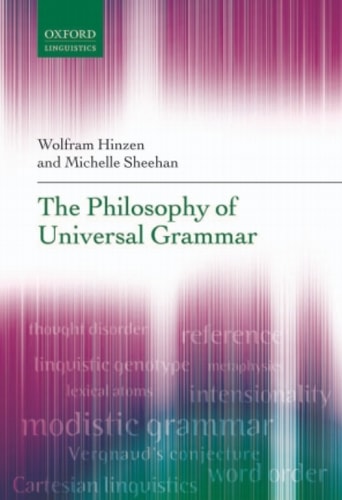
The Philosophy of Universal Grammar
0
0
As an Amazon Associate and affiliate partner, Menrva Books earns from qualifying purchases. Learn more
Author Description
What is grammar? Why does it exist? What difference, if any, does it make to the organization of meaning? This book seeks to give principled answers to these questions. Its topic is 'universal' grammar, in the sense that grammar is universal to human populations. But while modern generative grammar stands in the tradition of 'Cartesian linguistics' as emerging in the 17th century, this book re-addresses the question of the grammatical in a broader historical frame, taking inspiration from Modistic and Ancient Indian philosopher-linguists to formulate a different and 'Un-Cartesian' programme in linguistic theory. Its core claim is that the organization of the grammar is not distinct from the organization of human thought. This sapiens-specific mode of thought is uniquely propositional: grammar, therefore, organizes propositional forms of reference and makes knowledge possible. Such a claim has explanatory power as well: the grammaticalization of the hominin brain is critical to the emergence of our mind and our speciation. A thoroughly interdisciplinary endeavour, the book seeks to systematically integrate the philosophy of language and linguistic theory. It casts a fresh look at core issues that any philosophy of (universal) grammar will need to address, such as the distinction between lexical and grammatical meaning, the significance of part of speech distinctions, the grammar of reference and deixis, the relation between language and reality, and the dimensions of cross-linguistic and bio-linguistic variation.
Menrva's Summary
THE THESIS
This book investigates the fundamental nature of grammar and its role in the organization of human thought, proposing that grammar is not a distinct module but is intrinsically linked to propositional cognition. Authors Michelle Sheehan and Wolfram Hinzen, both established scholars in linguistic theory, challenge the traditional 'Cartesian' view of generative grammar. By integrating historical insights from Modistic and Ancient Indian traditions, they argue that the grammaticalization of the human brain was a critical factor in the emergence of the modern mind and human speciation.
THE SCOPE MAP
What You Will Find
- A historical re-evaluation of linguistic theory from the 17th century to the present.
- An analysis of the distinction between lexical and grammatical meaning.
- A framework for understanding the relationship between language, reference, and reality.
- Discussions on the significance of parts of speech and deixis.
Scope Limits
- The text does not provide a comprehensive history of all linguistic schools of thought.
- It focuses primarily on the theoretical intersection of philosophy and grammar rather than applied linguistics or language pedagogy.
THE AUTHORITY PERSPECTIVE
Experts recognize this work as a significant interdisciplinary contribution that bridges the gap between formal linguistics and philosophical inquiry. Readers frequently note the academic density of the prose, which requires a foundational understanding of generative grammar and cognitive philosophy to fully appreciate the authors' arguments.
Page Count:
400
Publication Date:
2013-01-01
Publisher:
OUP Oxford
ISBN-10:
0191626422
ISBN-13:
9780191626425
Philosophy
English & College Success
English
Philosophy of
Linguistics
Community Tags
Other Editions(3)
Similar Books

Reader Comments
Share Your Thoughts
No comments yet. Be the first to share your thoughts!