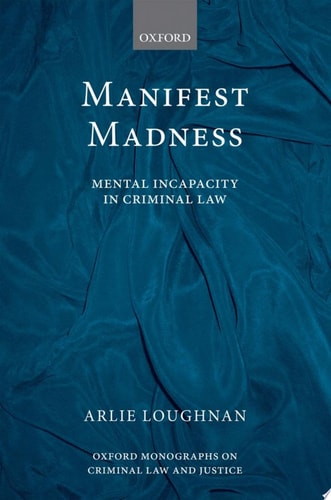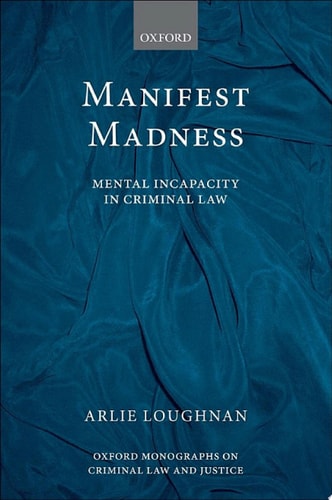
Manifest Madness: Mental Incapacity in the Criminal Law
0
0
As an Amazon Associate and affiliate partner, Menrva Books earns from qualifying purchases. Learn more
Author Description
This is an open access title available under the terms of a CC BY-NC-ND 3.0 International licence. It is free to read at Oxford Scholarship Online and offered as a free PDF download from OUP and selected open access locations. Whether it is a question of the age below which a child cannot be held liable for their actions, or the attribution of responsibility to defendants with mental illnesses, mental incapacity is a central concern for legal actors, policy makers, and legislators when it comes to crime and justice. Understanding mental incapacity in criminal law is notoriously difficult; it involves tracing overlapping and interlocking legal doctrines, current and past practices of evidence and proof, and also medical and social understandings of mental illness and incapacity. With its focus on the complex interaction of legal doctrines and practices relating to mental incapacity and knowledge - both expert and non-expert - of it, this book offers a fresh perspective on this topic. Bringing together previously disparate discussions on mental incapacity from law, psychology, and philosophy, this book provides a close study of this terrain of criminal law, analysing the development of mental incapacity doctrines through historical cases to the modern era. It maps the shifting boundaries around abnormality as constructed in law, arguing that the mental incapacity terrain has a distinct character - 'manifest madness'.
Menrva's Summary
THE THESIS
This book investigates the conceptual and practical framework of mental incapacity within criminal law, specifically examining how legal systems define and attribute responsibility to individuals deemed mentally impaired. Arlie Loughnan, a scholar in criminal law, synthesizes historical legal precedents, medical discourse, and philosophical inquiries to argue that the legal construction of mental incapacity has evolved into a distinct, identifiable category she terms 'manifest madness.' The work challenges the traditional view of these doctrines as static, proposing instead that they are dynamic constructs shaped by shifting societal and expert understandings of abnormality.
THE SCOPE MAP
What You Will Find
- Historical analysis of mental incapacity doctrines from early legal cases to contemporary standards.
- An interdisciplinary framework integrating legal theory, psychology, and philosophy.
- Examination of the interaction between expert testimony and non-expert legal decision-making.
Scope Limits
- The text focuses primarily on the construction of legal doctrine rather than providing a clinical manual for psychiatric diagnosis.
- It does not offer a comprehensive comparative study of international legal systems, focusing instead on the development of the doctrine within the common law tradition.
THE AUTHORITY PERSPECTIVE
Legal scholars and practitioners frequently cite this work as a rigorous examination of the intersection between mental health and criminal responsibility. Experts highlight the text for its academic depth and its ability to synthesize complex, disparate fields into a coherent legal argument.
Page Count:
307
Publication Date:
2012-01-01
Publisher:
OUP Oxford
ISBN-10:
0191627550
ISBN-13:
9780191627552
Psychology
Philosophy
Criminal Law
Mental Illness
Criminology
Legal History
Professional Career & Trade
Law
Community Tags
Other Editions(3)

Similar Books