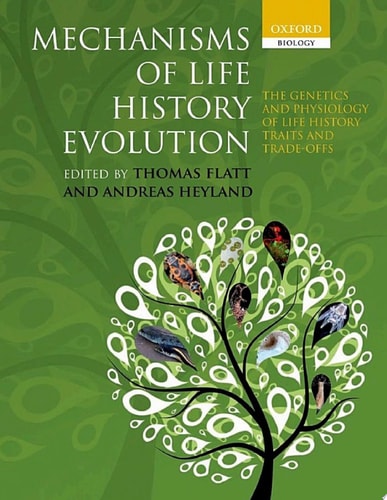
Mechanisms of Life History Evolution: The Genetics and Physiology of Life History Traits and Trade-Offs
0
0
As an Amazon Associate and affiliate partner, Menrva Books earns from qualifying purchases. Learn more
Author Description
Life history theory seeks to explain the evolution of the major features of life cycles by analyzing the ecological factors that shape age-specific schedules of growth, reproduction, and survival and by investigating the trade-offs that constrain the evolution of these traits. Although life history theory has made enormous progress in explaining the diversity of life history strategies among species, it traditionally ignores the underlying proximate mechanisms. This novel book argues that many fundamental problems in life history evolution, including the nature of trade-offs, can only be fully resolved if we begin to integrate information on developmental, physiological, and genetic mechanisms into the classical life history framework. Each chapter is written by an established or up-and-coming leader in their respective field; they not only represent the state of the art but also offer fresh perspectives for future research. The text is divided into 7 sections that cover basic concepts (Part 1), the mechanisms that affect different parts of the life cycle (growth, development, and maturation; reproduction; and aging and somatic maintenance) (Parts 2-4), life history plasticity (Part 5), life history integration and trade-offs (Part 6), and concludes with a synthesis chapter written by a prominent leader in the field and an editorial postscript (Part 7).
Menrva's Summary
THE THESIS
This book investigates how integrating developmental, physiological, and genetic mechanisms into classical life history theory can resolve fundamental problems regarding the evolution of life cycles and trade-offs. Edited by Andreas Heyland and Thomas Flatt, the text compiles contributions from leading researchers to bridge the gap between ecological life history models and the proximate biological mechanisms that constrain them. The authors argue that understanding the diversity of life history strategies requires a multi-level approach that accounts for the internal biological processes governing growth, reproduction, and aging.
THE SCOPE MAP
What You Will Find
- Theoretical frameworks for life history evolution
- Analysis of developmental and physiological mechanisms affecting maturation
- Examination of genetic underpinnings of life history plasticity
- Synthesis of trade-off mechanisms in somatic maintenance and reproduction
Scope Limits
- Does not provide an exhaustive survey of every known species' life cycle
- Focuses primarily on the integration of mechanisms rather than purely ecological or demographic modeling
THE AUTHORITY PERSPECTIVE
Experts recognize this volume as a significant contribution to the field for its attempt to synthesize proximate mechanisms with ultimate evolutionary causes. Readers frequently note the academic density of the prose, making it a resource primarily intended for graduate students and professional researchers in evolutionary biology.
Page Count:
505
Publication Date:
2011-01-01
Publisher:
OUP Oxford
ISBN-10:
0191621021
ISBN-13:
9780191621024
Science
Evolution
Biology
Genetics
Physiology
Life History Theory
Evolutionary Biology
Evolutionary genetics
Community Tags
Similar Books