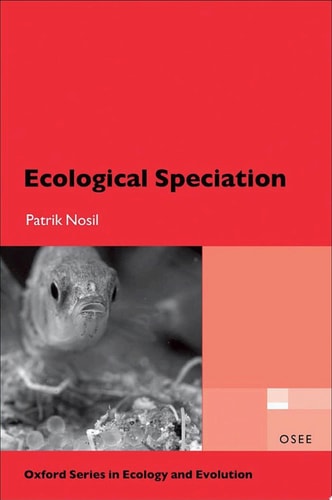
Ecological Speciation
0
0
As an Amazon Associate and affiliate partner, Menrva Books earns from qualifying purchases. Learn more
Author Description
The origin of biological diversity, via the formation of new species, can be inextricably linked to adaptation to the ecological environment. Specifically, ecological processes are central to the formation of new species when barriers to gene flow (reproductive isolation) evolve between populations as a result of ecologically-based divergent natural selection. This process of 'ecological speciation' has seen a large body of particularly focused research in the last 10-15 years, and a review and synthesis of the theoretical and empirical literature is now timely. The book begins by clarifying what ecological speciation is, its alternatives, and the predictions that can be used to test for it. It then reviews the three components of ecological speciation and discusses the geography and genomic basis of the process. A final chapter highlights future research directions, describing the approaches and experiments which might be used to conduct that future work. The ecological and genetic literature is integrated throughout the text with the goal of shedding new insight into the speciation process, particularly when the empirical data is then further integrated with theory.
Menrva's Summary
THE THESIS
This book investigates the role of ecologically-based divergent natural selection in the formation of new species and the evolution of reproductive isolation. Patrik Nosil, a researcher in evolutionary biology, synthesizes theoretical frameworks and empirical data to define the mechanisms of ecological speciation. The text provides a structured analysis of how environmental adaptation drives biological diversity and establishes criteria for testing these evolutionary predictions.
THE SCOPE MAP
What You Will Find
- Theoretical definitions and predictions regarding ecological speciation
- Analysis of the three primary components of the speciation process
- Examination of the geography and genomic basis of reproductive isolation
- Integration of ecological and genetic research methodologies
Scope Limits
- Does not cover non-ecological modes of speciation in depth
- Focuses primarily on research from the last 10-15 years rather than historical evolutionary theory
THE AUTHORITY PERSPECTIVE
Experts recognize this work as a comprehensive synthesis of modern research on ecological speciation. Readers frequently note the academic density of the prose, which is intended for researchers and advanced students in the biological sciences.
Page Count:
444
Publication Date:
2012-01-01
Publisher:
OUP Oxford
ISBN-10:
0191628026
ISBN-13:
9780191628023
Science
Evolutionary Biology
Ecology
Evolution
Biology
Species
Academic
Genetics
Community Tags
Other Editions(3)
Similar Books