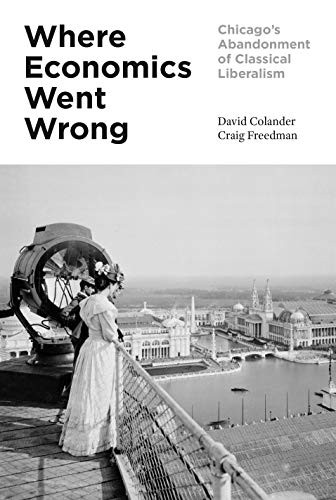
Where Economics Went Wrong
0
0
As an Amazon Associate and affiliate partner, Menrva Books earns from qualifying purchases. Learn more
Author Description
Milton Friedman once predicted that advances in scientific economics would resolve debates about whether raising the minimum wage is good policy. Decades later, Friedman's prediction has not come true. In Where Economics Went Wrong, David Colander and Craig Freedman argue that it never will. Why? Because economic policy, when done correctly, is an art and a craft. It is not, and cannot be, a science. The authors explain why classical liberal economists understood this essential difference, why modern economists abandoned it, and why now is the time for the profession to return to its classical liberal roots. Carefully distinguishing policy from science and theory, classical liberal economists emphasized values and context, treating economic policy analysis as a moral science where a dialogue of sensibilities and judgments allowed for the same scientific basis to arrive at a variety of policy recommendations. Using the University of Chicago--one of the last bastions of classical liberal economics--as a case study, Colander and Freedman examine how both the MIT and Chicago variants of modern economics eschewed classical liberalism in their attempt to make economic policy analysis a science. By examining the way in which the discipline managed to lose its bearings, the authors delve into such issues as the development of welfare economics in relation to economic science, alternative voices within the Chicago School, and exactly how Friedman got it wrong.
Menrva's Summary
THE THESIS
The book argues that economic policy analysis, when done correctly, is an art and a craft, not a science. David Colander and Craig Freedman contend that modern economists have mistakenly abandoned the classical liberal understanding of economic policy as a moral science, which emphasized values and context, leading to a variety of policy recommendations from a shared scientific basis. They trace this shift by examining how institutions like the University of Chicago, once a bastion of classical liberalism, saw its variants of modern economics eschew these roots in pursuit of scientific policy analysis. The authors explore the consequences of this shift, including the development of welfare economics and Milton Friedman's miscalculation regarding the scientific resolution of policy debates.
THE SCOPE MAP
- An examination of why economic policy is fundamentally an art and craft, not a science.
- An analysis of the historical shift from classical liberal economics to modern scientific approaches.
- A case study of the University of Chicago's economics departments and their embrace of modern economics.
- Discussion on the development of welfare economics in relation to economic science.
- An exploration of alternative voices within the Chicago School of economics.
- An explanation of Milton Friedman's misjudgment on the scientific resolution of economic policy debates.
THE AUTHORITY PERSPECTIVE
The book posits that the pursuit of scientific rigor in economic policy analysis has led the discipline astray, arguing for a return to classical liberal roots that embrace policy as an art and craft. It critiques modern economics for abandoning the emphasis on values and context that characterized earlier approaches, suggesting this shift has limited the diversity of policy recommendations. The authors use the University of Chicago as a focal point to illustrate how this transition occurred, examining the evolution of welfare economics and the specific missteps of influential figures like Milton Friedman. The work aims to distinguish between policy and science, advocating for a more nuanced understanding of economic analysis.
Page Count:
288
Publication Date:
2018-01-01
ISBN-10:
0691179204
ISBN-13:
9780691179209
History
Philosophy
Economics
Non-Fiction
Business
Community Tags
Similar Books














