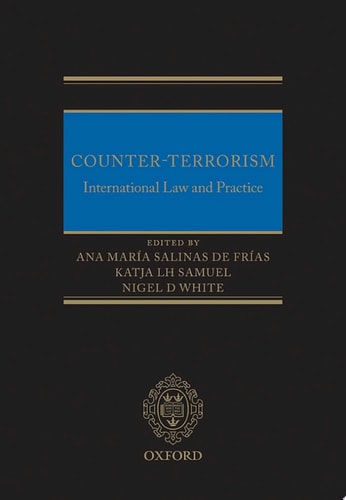
Counter-Terrorism: International Law and Practice
0
0
As an Amazon Associate and affiliate partner, Menrva Books earns from qualifying purchases. Learn more
Author Description
The responses of governments and international institutions to terrorism raise some of the most controversial issues of the twenty-first century. In particular, attempts to balance the desire to achieve security with the safeguarding of human rights and other aspects of the rule of law have proved to be highly contentious. This book is unique, not only in terms of its multinational, multidisciplinary nature, but also due to its truly comprehensive approach. It reviews, and examines, the interrelationship between the four principal elements of the international rule of law framework (international human rights, humanitarian, criminal, and refugee/asylum law) within in which counter-terrorism responses should occur. It focuses primarily on some of the most pressing, emerging, and/or under-researched issues and tensions. These include policy choices associated with meeting security imperatives; the tensions between the criminal justice, or preventive, approach to counter-terrorism and the military approach; the identification of lacunae within existing legal frameworks; and tensions between executive, judicial, and legislative responses. These matters are examined at the national, regional, and international levels. The book addresses a wide spectrum of issues, including analysis of key legal principles; emergency and executive measures; radicalization; governmental and institutional impunity; classification, administration and treatment of battlefield detainees; the use of lethal force; forms of, and treatment in, detention;non-refoulement; diplomatic assurances; interrogation versus torture; extraordinary rendition; discrimination; justice and reparations for victims of terrorist attacks and security responses; (mis)use of military courts, commissions, and immigration tribunals; judicial and institutional developed and emerging rule of law norms on terrorism; non-judicial oversight by means of democratic accountability; and the identification and analysis of best pra
Menrva's Summary
THE THESIS
How can international legal frameworks effectively balance state security imperatives with the preservation of human rights and the rule of law? The authors, a team of legal scholars and experts, synthesize international human rights, humanitarian, criminal, and refugee law to evaluate the legitimacy of modern counter-terrorism strategies. By examining the friction between executive, legislative, and judicial responses, the text provides a rigorous framework for assessing state conduct in the face of global security threats.
THE SCOPE MAP
What You Will Find
- Analysis of the four pillars of international law: human rights, humanitarian, criminal, and refugee law.
- Comparative study of national, regional, and international counter-terrorism policies.
- Examination of controversial practices including extraordinary rendition, detention, and the use of lethal force.
- Discussion of institutional accountability and judicial oversight mechanisms.
Scope Limits
- The text does not provide a comprehensive historical account of every global terrorist event.
- It does not offer a prescriptive policy manual for individual law enforcement agencies.
THE AUTHORITY PERSPECTIVE
Experts and legal practitioners frequently cite this work as a comprehensive reference for understanding the intersection of security policy and international legal norms. Readers often note the academic density of the prose, which makes it a suitable resource for advanced students and professionals in the field of international law.
Page Count:
1220
Publication Date:
2012-01-01
Publisher:
OUP Oxford
ISBN-10:
019162781X
ISBN-13:
9780191627811
Counter Terrorism
Law
Professional Career & Trade
International relations
Terrorism
Human rights
Community Tags
Similar Books






Reader Comments
Share Your Thoughts
No comments yet. Be the first to share your thoughts!