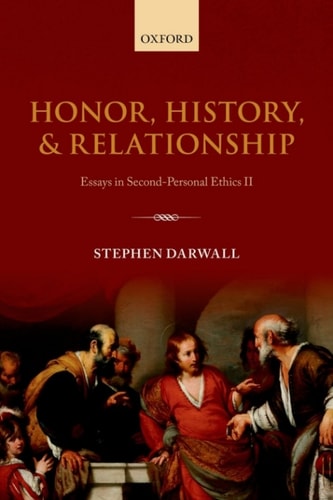
Honor, History, and Relationship: Essays in Second-Personal Ethics II
0
0
As an Amazon Associate and affiliate partner, Menrva Books earns from qualifying purchases. Learn more
Author Description
In Honor, History, and Relationship Stephen Darwall explores the idea of a second-personal framework for morality and its foundations, in which we are committed to morality by presuppositions that are inescapable when we relate to others (person to person). He expands on the argument set forth in The Second-Person Standpoint to explore the second-personal framework in three further settings. The first concerns a fundamental difference between the form that respect and the concept of person take in honor cultures, on the one hand, and the shape these assume in morality conceived as equal accountability, on the other. One essay explores this difference directly while others investigate related themes of justice versus retaliation and vengeance for insult and injury to honor, including in the writings of Adam Smith and Nietzsche on ressentiment. A second setting concerns the role of second-personal ideas in the development of a distinctively "modern" moral philosophy, beginning in seventeenth-century Europe. Two essays here discuss the centrality of second-personal notions in two formative modern natural law theorists: Grotius and Pufendorf. And two others concentrate on the role of reciprocal recognition in Kant and Fichte, respectively. A third group of essays treat the second-personal structure of interpersonal relations. There are three essays in this group: one on promising as a second-personal transaction between promiser and promisee, a second on what it is to be with another person, and a third on the role of second-personal standing in personal relationships.
Menrva's Summary
THE THESIS
How does a second-personal framework for morality function across historical, cultural, and interpersonal contexts? Stephen Darwall, a prominent moral philosopher, utilizes his established framework of second-personal accountability to investigate the foundations of moral obligation. He argues that moral commitments are inherently tied to the presuppositions we make when relating to others as persons, extending this analysis beyond his previous work to examine honor cultures, the evolution of modern moral philosophy, and the nature of personal relationships.
THE SCOPE MAP
What You Will Find
- Comparative analysis of honor cultures versus equal accountability morality
- Historical examination of natural law theorists including Grotius, Pufendorf, Kant, and Fichte
- Philosophical investigation into the mechanics of promising and interpersonal recognition
- Theoretical exploration of ressentiment in the works of Adam Smith and Nietzsche
Scope Limits
- The text does not provide a general introduction to ethics for laypeople
- It does not cover non-Western moral frameworks outside of the specified historical scope
THE AUTHORITY PERSPECTIVE
Experts recognize this collection as a significant expansion of Darwall's foundational work on the second-person standpoint. Readers frequently note the academic density of the prose, which is intended for scholars and advanced students of moral philosophy.
Page Count:
285
Publication Date:
2013-01-01
Publisher:
OUP Oxford
ISBN-10:
0191639591
ISBN-13:
9780191639593
Philosophy
Non-Fiction
Ethics
Moral Philosophy
Academic
Community Tags
Similar Books