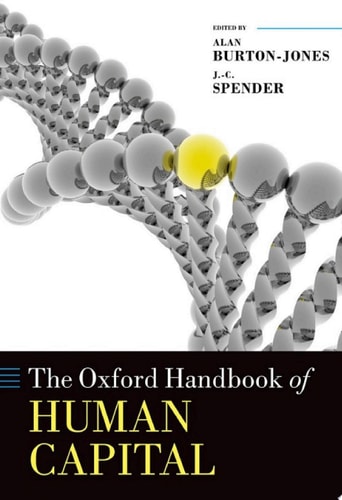
The Oxford Handbook of Human Capital
0
0
As an Amazon Associate and affiliate partner, Menrva Books earns from qualifying purchases. Learn more
Author Description
Macroeconomic research on human capital - the stock of human capabilities and knowledge - has been extensively published but to date the literature has lacked a comprehensive analysis of human capital within the organization. The Oxford Handbook of Human Capital has been designed to fill that gap, providing an authoritative, inter-disciplinary, and up to date survey of relevant concepts, research areas, and applications. Specially commissioned contributions from over 40 authors reveal the importance of human capital for contemporary organizations, exploring its conceptual underpinnings, relevance to theories of the firm, implications for organizational effectiveness, interdependencies with other resources, and role in the future economy. Unlike neoclassical macroeconomic concepts of human capital, human capital in organizations is shown to be dynamic and heterogeneous, requiring new theories and management frameworks. The systemic role of human capital is explored, revealing it as the lynchpin of social, structural and other forms of intangible and tangible capital. Connections between human capital and organizational performance are investigated from HR management, procurement, alignment, value appropriation, and accounting perspectives. Links between micro and macro perspectives are provided through analyses of inter firm human capital mobility, national and regional human capital formation regimes and industry employment relations practices. This Handbook is designed for scholars and graduate students of organization and management theory, strategy, entrepreneurship, knowledge and intellectual capital, accounting, IT, HR, IR, economic sociology and cultural studies. For policy makers and practitioners it should provide an up to date guide to the nature and role of human capital in contemporary organizations and the roles that government, industry and other extra firm institutions can play in facilitating its development.
Menrva's Summary
THE THESIS
This handbook investigates the role, management, and systemic importance of human capital within the organizational context rather than the traditional macroeconomic framework. The editors, Alan Burton-Jones and J.-C. Spender, curate contributions from over 40 experts to bridge the gap between micro-level organizational behavior and macro-level economic theory. The text argues that human capital is a dynamic, heterogeneous asset that serves as the lynchpin for various forms of organizational capital.
THE SCOPE MAP
What You Will Find
- Theoretical frameworks regarding human capital in the firm
- Analysis of human capital mobility and inter-firm dynamics
- Integration of HR management, accounting, and strategy perspectives
- Examination of national and regional human capital formation
Scope Limits
- Does not focus on neoclassical macroeconomic models of human capital
- Excludes basic introductory concepts for non-academic readers
THE AUTHORITY PERSPECTIVE
Experts and scholars identify this volume as a foundational interdisciplinary resource for graduate-level management and organizational studies. Readers frequently note the academic density of the prose, which is tailored specifically for researchers, policy makers, and advanced practitioners.
Page Count:
711
Publication Date:
2012-01-01
Publisher:
OUP Oxford
ISBN-10:
0191634964
ISBN-13:
9780191634963
Economics
Business
Management
Organizational Theory
Human Resources
Community Tags
Other Editions(3)

Similar Books










Reader Comments
Share Your Thoughts
No comments yet. Be the first to share your thoughts!