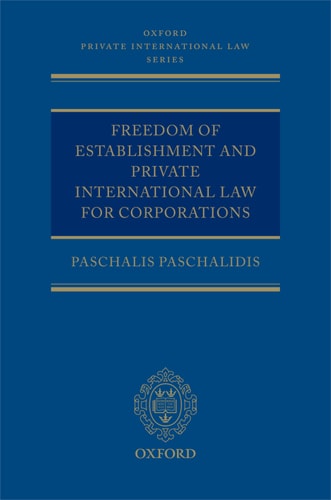
Freedom of Establishment and Private International Law for Corporations
0
0
As an Amazon Associate and affiliate partner, Menrva Books earns from qualifying purchases. Learn more
Author Description
Freedom of establishment is one of the four fundamental freedoms of the European Union. The principle is that natural persons who are European Union Citizens, and legal entities formed in accordance with the law of a Member State and having its registered office, central administration or principal place of business within the EU, may take up economic activity in any Member State in a stable and continuous form regardless of nationality or mode of incorporation. This book examines the way in which EU law has influenced how national courts in Europe assert jurisdiction in cross-border corporate disputes and insolvencies, and the mechanism which allows them to decide which national law should apply to the substance of the dispute. The book also considers the potential for EU Member States to compete for devising national corporate and insolvency legislation that will attract incorporations or insolvencies. Central to the book is the concept of national choice of law. In considering the impact of freedom of establishment on private international law for corporations, the book uniquely analyses both corporate and insolvency law together, presenting the topic in the broadest possible sense. Importantly, the doctrine of abuse in corporate and insolvency law is covered, raising the question of 'forum shopping' and regulatory competition which underpins the intersection between freedom of establishment and private international law. Through examination of the most recent and leading judgments of the European Court of Justice in Centros and Cadbury Schweppes, the book derives certain conclusions as to the operation of the doctrine of abuse and the limits thereof in the context of freedom of establishment. Being the first in the field to examine the leading ECJ cases of Inspire Art, Sevic and Cartesio regarding the real seat doctrine, the book makes the judgment that there is no incompatibility as such between the doctrine and the freedom of establishment.
Menrva's Summary
THE THESIS
This book investigates how the European Union's freedom of establishment principle intersects with and influences private international law regarding corporate jurisdiction and insolvency. Paschalis Paschalidis, an expert in European legal frameworks, utilizes a comprehensive analysis of European Court of Justice jurisprudence to evaluate how national courts determine applicable law in cross-border disputes. The text argues that the freedom of establishment does not inherently conflict with the real seat doctrine, while exploring the implications of regulatory competition and forum shopping among Member States.
THE SCOPE MAP
What You Will Find
- Analysis of landmark European Court of Justice rulings including Centros, Cadbury Schweppes, Inspire Art, Sevic, and Cartesio.
- Examination of the intersection between corporate law and insolvency law within the EU.
- Discussion on the doctrine of abuse and its limits regarding corporate mobility.
Scope Limits
- The text focuses primarily on the EU legal framework and does not provide an exhaustive comparative study of non-EU jurisdictions.
- It does not serve as a general practitioner's handbook for individual corporate litigation but rather as a theoretical and analytical legal treatise.
THE AUTHORITY PERSPECTIVE
Legal scholars and practitioners frequently cite this work as a foundational text for understanding the complexities of corporate mobility within the European Union. Experts highlight the author's rigorous synthesis of case law as a critical resource for those navigating the intersection of private international law and EU fundamental freedoms.
Page Count:
321
Publication Date:
2012-01-01
Publisher:
OUP Oxford
ISBN-10:
0191638137
ISBN-13:
9780191638138
International Law
Law
Insolvency Law
Professional Career & Trade
Academic
Corporate Law
European Union
Community Tags
Other Editions(2)
Similar Books







Reader Comments
Share Your Thoughts
No comments yet. Be the first to share your thoughts!