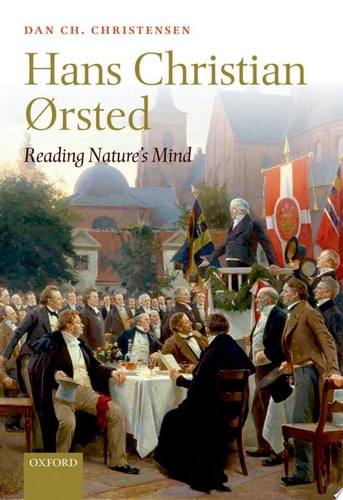
Hans Christian Ørsted: Reading Nature's Mind
0
0
As an Amazon Associate and affiliate partner, Menrva Books earns from qualifying purchases. Learn more
Author Description
Hans Christian Orsted (1777-1851) is of great importance as a scientist and philosopher far beyond the borders of Denmark and his own time. At the centre of an international network of scholars, he was instrumental in founding the world picture of modern physics. Orsted was the physicist who brought Kant's metaphysics to fruition. In 1820 his discovery of electro-magnetism, a phenomenon that could not possibly exist according to his adversaries, changed the course of research in physics. It inspired Michael Faraday's experiments and discovery of the adverse effect, magneto-electric induction. The two physical phenomena were later described in mathematical equations by J.C. Maxwell. Together these discoveries constitute the prerequisites for the overwhelming development of modern technology. But Orsted was also one of the cultural leaders and organizers of the Danish Golden Age (together with Grundtvig, Kierkegaard, and Hans-Christian Andersen, his protege), and made significant contributions to aesthetics, philosophy, pedagogy, politics, and religion. Orsted remarkably bridged the gap between science, the humanities, and the arts.
Menrva's Summary
THE THESIS
This biography investigates how Hans Christian Ørsted synthesized Kantian metaphysics with experimental physics to fundamentally alter the trajectory of modern scientific thought. Dan Ch. Christensen, a scholar of Danish intellectual history, utilizes primary source correspondence and scientific records to reconstruct Ørsted's life. The author argues that Ørsted's discovery of electromagnetism was not an isolated event but the result of a deliberate philosophical framework that sought to unify the natural sciences with the humanities and arts.
THE SCOPE MAP
What You Will Find
- Detailed analysis of the 1820 discovery of electromagnetism and its subsequent influence on Michael Faraday and J.C. Maxwell.
- Examination of Ørsted's role as a central figure in the Danish Golden Age alongside contemporaries like Kierkegaard and Hans Christian Andersen.
- Exploration of Ørsted's contributions to aesthetics, pedagogy, and religious philosophy.
Scope Limits
- The text does not provide a comprehensive technical manual for the mathematical equations later derived by Maxwell.
- The narrative focus remains primarily on the European intellectual context rather than a global history of physics.
THE AUTHORITY PERSPECTIVE
Scholars and historians of science frequently cite this work as a definitive account of Ørsted's multifaceted career and his unique position at the intersection of Romantic philosophy and empirical science. Readers often note the academic density of the prose, which provides a rigorous look at the intellectual climate of the nineteenth century.
Page Count:
768
Publication Date:
2013-01-01
Publisher:
OUP Oxford
ISBN-10:
019164711X
ISBN-13:
9780191647116
Biography
Philosophy
Intellectual History
Science History
Danish History
Physicists biography
Physics
Community Tags
Similar Books