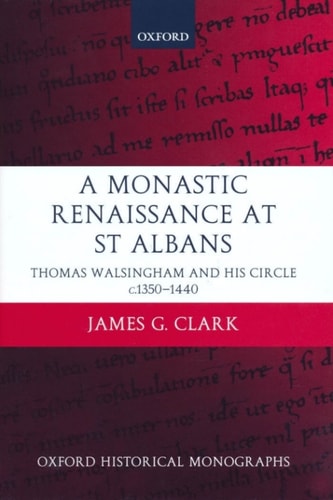
A Monastic Renaissance at St Albans: Thomas Walsingham and His Circle c.1350-1440
0
0
As an Amazon Associate and affiliate partner, Menrva Books earns from qualifying purchases. Learn more
Author Description
A Monastic Renaissance at St Albans is a study of intellectual life at the abbey of St Albans - one of Britain's greatest Benedictine monasteries - during the lifetime of Thomas Walsingham (c.1340-1422), one of the most prolific scholars of the later middle ages. It has always been assumed that the monasteries fell into decline long before the dissolution and that cultural and intellectual activities were largely abandoned as the monks surrendered themselves to high living and low morals. This study challenges this view. Drawing on a wide variety of manuscript sources, it shows that education, independent study, and even the co-ordinated copying of books continued to flourish at St Albans (and its affiliate houses) for much of the fourteenth and fifteenth centuries. In fact the abbey emerged as one of the country's most influential centres of learning, a clearing-house for books and ideas in Ricardian and Lancastrian England. Thomas Walsingham himself played a key part in this renaissance in monastic studies; his works were copied and circulated throughout the St Albans network and his influence acted upon the next generation of monastic readers and writers. Walsingham was not only a compiler of contemporary chronicles but also a Classical scholar of extraordinary originality. His commentary on Ovid's Metamorphoses, his re-working of the histories of Alexander of Macedon and the Trojan War, and his Genealogia deorum gentilium, are discussed in detail here for the first time. Walsingham's interest in the Classics was shared by many of his St Albans colleagues, and they in turn were members of a wider circle of literary scholars, which included the London schoolmaster, John Seward. The work of these scholars, monastic and secular, points towards a revival of Classical and literary scholarship in England long before Italian humanism and other traces of the continental Renaissance first found their way into the country.
Menrva's Summary
THE THESIS
This study investigates whether the Benedictine monasteries of late medieval England experienced a period of intellectual decline or a sustained cultural renaissance. James G. Clark, a specialist in monastic history, utilizes extensive manuscript evidence from the abbey of St Albans to challenge the traditional historiographical narrative of monastic decay. He argues that the institution served as a vital hub for classical scholarship and literary production during the fourteenth and fifteenth centuries, centered around the work of Thomas Walsingham.
THE SCOPE MAP
What You Will Find
- Analysis of the intellectual output of St Albans Abbey between 1350 and 1440.
- Examination of Thomas Walsingham’s classical commentaries, including his work on Ovid and the histories of Alexander and Troy.
- Investigation into the collaborative networks between monastic scholars and secular figures like John Seward.
Scope Limits
- The study focuses primarily on the St Albans network and does not provide a comprehensive survey of all English Benedictine houses.
- The analysis is restricted to the intellectual and literary activities of the period rather than the broader economic or political history of the monastery.
THE AUTHORITY PERSPECTIVE
Scholars recognize this work as a significant revisionist study that effectively dismantles long-standing assumptions regarding the cultural stagnation of late medieval English monasteries. Readers frequently note the academic density of the prose and the meticulous archival research that supports the author's claims.
Page Count:
330
Publication Date:
2005-01-01
Publisher:
Clarendon Press
ISBN-10:
0191515310
ISBN-13:
9780191515316
History
Biography
Intellectual History
Monastic Studies
British History
European History
Community Tags
Similar Books