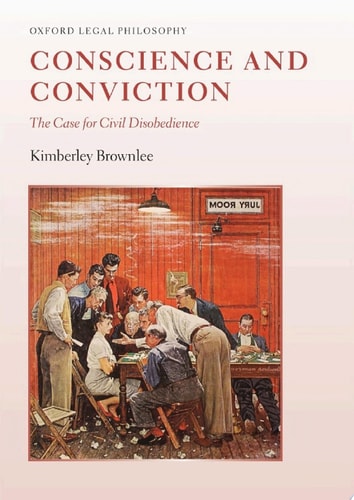
Conscience and Conviction: The Case for Civil Disobedience
0
0
As an Amazon Associate and affiliate partner, Menrva Books earns from qualifying purchases. Learn more
Author Description
The book shows that civil disobedience is generally more defensible than private conscientious objection. Part I explores the morality of conviction and conscience. Each of these concepts informs a distinct argument for civil disobedience. The conviction argument begins with the communicative principle of conscientiousness (CPC). According to the CPC, having a conscientious moral conviction means not just acting consistently with our beliefs and judging ourselves and others by a common moral standard. It also means not seeking to evade the consequences of our beliefs and being willing to communicate them to others. The conviction argument shows that, as a constrained, communicative practice, civil disobedience has a better claim than private objection does to the protections that liberal societies give to conscientious dissent. This view reverses the standard liberal picture which sees private 'conscientious' objection as a modest act of personal belief and civil disobedience as a strategic, undemocratic act whose costs are only sometimes worth bearing. The conscience argument is narrower and shows that genuinely morally responsive civil disobedience honours the best of our moral responsibilities and is protected by a duty-based moral right of conscience. Part II translates the conviction argument and conscience argument into two legal defences. The first is a demands-of-conviction defence. The second is a necessity defence. Both of these defences apply more readily to civil disobedience than to private disobedience. Part II also examines lawful punishment, showing that, even when punishment is justifiable, civil disobedients have a moral right not to be punished. Oxford Legal Philosophy publishes the best new work in philosophically-oriented legal theory. It commissions and solicits monographs in all branches of the subject, including works on philosophical issues in all areas of public and private law, and in the national, transnational, and international realms;
Menrva's Summary
THE THESIS
This work investigates whether civil disobedience possesses a stronger moral and legal justification than private conscientious objection within the framework of liberal democratic societies. Kimberley Brownlee, a scholar in legal and political philosophy, utilizes moral theory and legal analysis to challenge the traditional liberal view that prioritizes private objection over public dissent. She proposes that civil disobedience, when practiced as a communicative and constrained act, aligns more closely with the requirements of moral conscientiousness and deserves greater legal protection than previously acknowledged.
THE SCOPE MAP
What You Will Find
- The Communicative Principle of Conscientiousness (CPC) as a framework for evaluating moral conviction.
- Analysis of the 'demands-of-conviction' and 'necessity' legal defenses.
- Arguments regarding the moral right of civil disobedients to avoid punishment.
Scope Limits
- The text focuses primarily on the philosophical and legal justifications within liberal democratic systems.
- It does not provide a comprehensive historical survey of all global civil disobedience movements.
THE AUTHORITY PERSPECTIVE
Legal scholars and philosophers frequently cite this text as a rigorous contribution to the discourse on political obligation and the limits of law. Readers often note the high level of academic density, making it a specialized resource for those already familiar with contemporary legal philosophy.
Page Count:
278
Publication Date:
2012-01-01
Publisher:
OUP Oxford
ISBN-10:
0191645923
ISBN-13:
9780191645921
Philosophy
Professional Career & Trade
Legal Theory
Law
Ethics
Community Tags
Similar Books