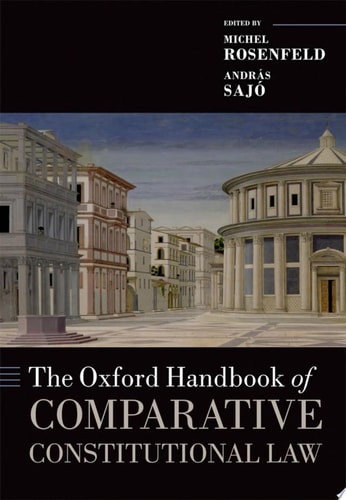
The Oxford Handbook of Comparative Constitutional Law
0
0
As an Amazon Associate and affiliate partner, Menrva Books earns from qualifying purchases. Learn more
Author Description
The field of comparative constitutional law has grown immensely over the past couple of decades. Once a minor and obscure adjunct to the field of domestic constitutional law, comparative constitutional law has now moved front and centre. Driven by the global spread of democratic government and the expansion of international human rights law, the prominence and visibility of the field, among judges, politicians, and scholars has grown exponentially. Even in the United States, where domestic constitutional exclusivism has traditionally held a firm grip, use of comparative constitutional materials has become the subject of a lively and much publicized controversy among various justices of the U.S. Supreme Court. The trend towards harmonization and international borrowing has been controversial. Whereas it seems fair to assume that there ought to be great convergence among industrialized democracies over the uses and functions of commercial contracts, that seems far from the case in constitutional law. Can a parliamentary democracy be compared to a presidential one? A federal republic to a unitary one? Moreover, what about differences in ideology or national identity? Can constitutional rights deployed in a libertarian context be profitably compared to those at work in a social welfare context? Is it perilous to compare minority rights in a multi-ethnic state to those in its ethnically homogeneous counterparts? These controversies form the background to the field of comparative constitutional law, challenging not only legal scholars, but also those in other fields, such as philosophy and political theory. Providing the first single-volume, comprehensive reference resource, the 'Oxford Handbook of Comparative Constitutional Law' will be an essential road map to the field for all those working within it, or encountering it for the first time. Leading experts in the field examine the history and methodology of the discipline, the central concepts of constitutional law, con
Menrva's Summary
THE THESIS
This volume investigates the methodological challenges and theoretical foundations of comparative constitutional law in an era of increasing global legal interaction. Editors András Sajó and Michael J. Rosenfeld compile contributions from leading legal scholars to address whether constitutional systems—ranging from parliamentary to presidential and federal to unitary—can be meaningfully compared. The text examines the tensions between domestic constitutional traditions and the growing trend of international borrowing and harmonization.
THE SCOPE MAP
What You Will Find
- Analysis of the history and methodology of comparative constitutional law.
- Examination of central concepts such as rights, separation of powers, and judicial review.
- Comparative studies of diverse political systems including multi-ethnic states and social welfare democracies.
Scope Limits
- The text does not provide a comprehensive survey of every national constitution in existence.
- It does not offer a definitive resolution to the normative debates regarding the legitimacy of judicial borrowing.
THE AUTHORITY PERSPECTIVE
Legal scholars and practitioners recognize this handbook as a foundational reference for the discipline. Readers frequently note the academic density of the prose, which serves as a rigorous resource for those navigating the complexities of global constitutional theory.
Page Count:
1416
Publication Date:
2012-01-01
Publisher:
Oup Oxford
ISBN-10:
0191640166
ISBN-13:
9780191640162
Academic
Law
Comparative Law
Constitutional Law
Reference
Community Tags
Other Editions(2)
Similar Books







Reader Comments
Share Your Thoughts
No comments yet. Be the first to share your thoughts!