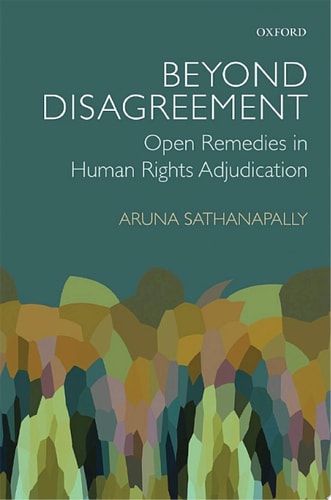
Beyond Disagreement: Open Remedies in Human Rights Adjudication
0
0
As an Amazon Associate and affiliate partner, Menrva Books earns from qualifying purchases. Learn more
Author Description
Examining the role of 'open remedies' in human rights adjudication, this book provides a new perspective informing comparative constitutional debates on how to structure institutional relationships over fundamental rights and freedoms. Open remedies declare a human rights violation but invite the other branches of government to decide what corrective action should be taken. Open remedies are premised on the need to engage institutions beyond courts in the process of thinking about and acting on human rights problems. This book considers examples across the United States, South Africa, Canada, and internationally, emphasising their similarities and differences in design and the diverse ways they could operate in practice. he book investigates these possibilities through the first systematic legal and empirical study of the declaration of incompatibility model under the United Kingdom Human Rights Act. This new model provides a non-binding declaration that the law has infringed human rights standards, for the legislature's consideration. By design, it has the potential to support democratic deliberation on what human rights require of the laws and policies of the State, however, it also carries uncertainties and risks. Providing a lucid account of existing debates on the relative roles of courts and legislatures to determine the requirements of fundamental rights commitments, the book argues that we need to look beyond the theoretical focus on rights disagreements, to how these remedies have operated in practice across the courts and the political branches of government. Importantly, we should pay attention to the nature and scope of legislative engagement in deliberation on the human rights matters raised by declarations of incompatibility. Adopting this approach, this book presents a carefully argued view of how courts have exercised this power, as well as how the UK executive and Parliament have responded to its use.
Menrva's Summary
THE THESIS
How can 'open remedies' in human rights adjudication foster more effective institutional collaboration between judicial and legislative branches? Aruna Sathanapally, a legal scholar, examines the structural dynamics of human rights enforcement by analyzing how courts can declare violations while deferring corrective action to political institutions. The book argues that shifting the focus from theoretical rights disagreements to the practical operation of these remedies reveals new pathways for democratic deliberation on fundamental freedoms.
THE SCOPE MAP
What You Will Find
- A systematic legal and empirical study of the declaration of incompatibility model under the UK Human Rights Act.
- Comparative analysis of human rights adjudication across the United States, South Africa, and Canada.
- A framework for evaluating legislative engagement in response to judicial declarations of rights infringements.
Scope Limits
- The analysis does not provide a comprehensive review of every global human rights jurisdiction.
- The study focuses primarily on the institutional design of remedies rather than the substantive merits of individual human rights cases.
THE AUTHORITY PERSPECTIVE
Legal scholars and practitioners view this work as a significant contribution to comparative constitutional law, particularly regarding the separation of powers. Readers frequently note the academic density of the prose, which is well-suited for researchers and policy analysts interested in the intersection of judicial review and legislative process.
Page Count:
256
Publication Date:
2012-01-01
Publisher:
OUP Oxford
ISBN-10:
0191647985
ISBN-13:
9780191647987
Human rights
Constitutional Law
Government
Comparative Law
Professional Career & Trade
Law
Community Tags
Other Editions(2)

Similar Books




Reader Comments
Share Your Thoughts
No comments yet. Be the first to share your thoughts!