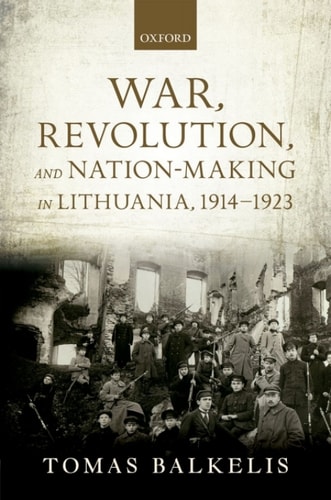
War, Revolution, and Nation-Making in Lithuania, 1914-1923
0
0
As an Amazon Associate and affiliate partner, Menrva Books earns from qualifying purchases. Learn more
Author Description
In this book, Tomas Balkelis explores how the Lithuanian state was created and shaped by the Great War from its onset in 1914 to the last waves of violence in 1923. As the very notion of independent Lithuania was constructed during the war, violence is seen as an essential part of the formation of Lithuanian state, nation, and identity. War was much more than simply the historical context in which the tectonic shift from empire to nation-state took place. It transformed people, policies, institutions, and modes of thought in ways that would continue to shape the nation for decades after the conflict subsided. In telling the story of the post-WWI conflict in Lithuania, War, Revolution, and Nation-Making in Lithuania, 1914-1923 focuses on the soldiers and civilians involved in the conflict, rather than the strategies and acts of politicians, generals, or diplomats. The volume's two main themes are the impact of military, social, and cultural mobilizations on the local population, and different types of violence that were so characteristic of the region throughout the period. The actors in this story are people displaced by war and mobilized for war: refugees, veterans, volunteers, peasant conscripts, POWs, paramilitary fighters, and others who took to guns, not diplomacy, to assert their power. This is the story of how their lives were changed by war and how they shaped the society that emerged after war.
Menrva's Summary
THE THESIS
This work investigates how the experience of total war and subsequent regional violence served as the primary catalyst for the construction of the Lithuanian state and national identity between 1914 and 1923. Tomas Balkelis, a historian specializing in East European history, utilizes a bottom-up approach to analyze the transition from imperial rule to nation-statehood. He argues that the conflict was not merely a backdrop but a transformative force that fundamentally altered social structures, institutional policies, and individual modes of thought among the Lithuanian population.
THE SCOPE MAP
What You Will Find
- Analysis of the transition from the Russian Empire to an independent Lithuanian state.
- Examination of social and cultural mobilization during the Great War and its aftermath.
- Documentation of the roles played by refugees, veterans, and paramilitary fighters.
- Study of the impact of systemic violence on local civilian populations.
Scope Limits
- The text intentionally minimizes the focus on high-level diplomatic negotiations and military strategy.
- The analysis is geographically confined to the Lithuanian territory and its immediate border conflicts.
THE AUTHORITY PERSPECTIVE
Scholars in the field of East European studies identify this work as a significant contribution to understanding the social history of the post-WWI era. Readers frequently note the academic density of the prose and the author's success in centering the experiences of ordinary citizens over political elites.
Page Count:
208
Publication Date:
2018-01-01
Publisher:
OUP Oxford
ISBN-10:
0191644854
ISBN-13:
9780191644856
History
Lithuanian History
Social History
European History
Military History