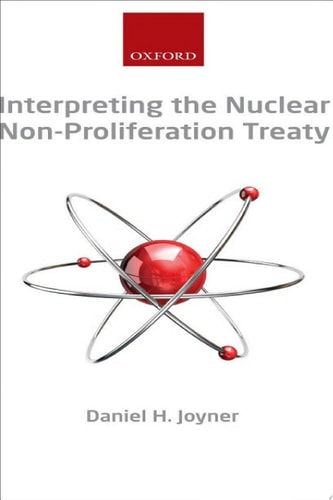
Interpreting the Nuclear Non-Proliferation Treaty
0
0
As an Amazon Associate and affiliate partner, Menrva Books earns from qualifying purchases. Learn more
Author Description
The 1968 Nuclear Non-proliferation Treaty has proven the most complicated and controversial of all arms control treaties, both in principle and in practice. Statements of nuclear-weapon States from the Cold War to the present, led by the United States, show a disproportionate prioritization of the non-proliferation pillar of the Treaty, and an unwarranted underprioritization of the civilian energy development and disarmament pillars of the treaty. This book argues that the way in which nuclear-weapon States have interpreted the Treaty has laid the legal foundation for a number of policies related to trade in civilian nuclear energy technologies and nuclear weapons disarmament. These policies circumscribe the rights of non-nuclear-weapon States under Article IV of the Treaty by imposing conditions on the supply of civilian nuclear technologies. They also provide for the renewal and maintaintenance, and in some cases further development of the nuclear weapons arsenals of nuclear-weapon States. The book provides a legal analysis of this trend in treaty interpretation by nuclear-weapon States and the policies for which it has provided legal justification. It argues, through a close and systematic examination of the Treaty by reference to the rules of treaty interpretation found in the 1969 Vienna Convention on the Law of Treaties, that this disproportionate prioritization of the non-proliferation pillar of the Treaty leads to erroneous legal interpretations in light of the original balance of principles underlying the Treaty, prejudicing the legitimate legal interests of non-nuclear-weapon States.
Menrva's Summary
THE THESIS
This book investigates whether the current interpretation of the Nuclear Non-Proliferation Treaty by nuclear-weapon States aligns with the original legal balance of the agreement. Daniel H. Joyner, a scholar of international law, utilizes the framework of the 1969 Vienna Convention on the Law of Treaties to evaluate how major powers have prioritized non-proliferation over civilian energy and disarmament obligations. He argues that this selective interpretation has created a legal foundation for policies that unfairly restrict the rights of non-nuclear-weapon States while allowing for the maintenance and expansion of existing nuclear arsenals.
THE SCOPE MAP
What You Will Find
- Legal analysis of the 1968 Nuclear Non-Proliferation Treaty
- Systematic application of the 1969 Vienna Convention on the Law of Treaties
- Examination of policies regarding civilian nuclear energy technology trade
- Critique of the prioritization of treaty pillars by nuclear-weapon States
Scope Limits
- Does not provide a comprehensive history of every individual nuclear state's foreign policy
- Does not focus on the technical engineering aspects of nuclear energy
THE AUTHORITY PERSPECTIVE
Experts in international law recognize this work as a rigorous legal critique of treaty interpretation practices. Readers frequently note the academic density of the prose and the author's precise application of international legal standards to complex geopolitical issues.
Page Count:
198
Publication Date:
2012-01-01
Publisher:
OUP Oxford
ISBN-10:
0191648787
ISBN-13:
9780191648786
International Law
Professional Career & Trade
Nuclear Nonproliferation
Nuclear Proliferation
Arms Control
International relations
Community Tags
Other Editions(3)

Similar Books


Reader Comments
Share Your Thoughts
No comments yet. Be the first to share your thoughts!