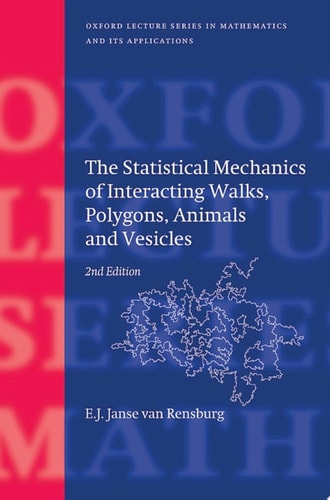
The Statistical Mechanics of Interacting Walks, Polygons, Animals and Vesicles
0
0
As an Amazon Associate and affiliate partner, Menrva Books earns from qualifying purchases. Learn more
Author Description
The self-avoiding walk is a classical model in statistical mechanics, probability theory and mathematical physics. It is also a simple model of polymer entropy which is useful in modelling phase behaviour in polymers. This monograph provides an authoritative examination of interacting self-avoiding walks, presenting aspects of the thermodynamic limit, phase behaviour, scaling and critical exponents for lattice polygons, lattice animals and surfaces. It also includes a comprehensive account of constructive methods in models of adsorbing, collapsing, and pulled walks, animals and networks, and for models of walks in confined geometries. Additional topics include scaling, knotting in lattice polygons, generating function methods for directed models of walks and polygons, and an introduction to the Edwards model. This essential second edition includes recent breakthroughs in the field, as well as maintaining the older but still relevant topics. New chapters include an expanded presentation of directed models, an exploration of methods and results for the hexagonal lattice, and a chapter devoted to the Monte Carlo methods.
Menrva's Summary
THE THESIS
This monograph investigates the mathematical properties and thermodynamic behavior of self-avoiding walks, polygons, animals, and vesicles as models for polymer systems. E. J. Janse van Rensburg, a specialist in the field, synthesizes complex probabilistic and physical models to explain phase behavior and scaling limits. The text provides a rigorous framework for understanding how these lattice-based models represent physical phenomena in confined or interacting geometries.
THE SCOPE MAP
What You Will Find
- Thermodynamic limits and critical exponents for lattice models
- Constructive methods for adsorbing, collapsing, and pulled walks
- Analysis of knotting in lattice polygons and directed models
- Monte Carlo simulation methodologies
- Mathematical treatment of the Edwards model
Scope Limits
- The text assumes a high level of mathematical maturity and prior knowledge of statistical mechanics
- It focuses primarily on lattice-based models rather than continuous space polymer physics
THE AUTHORITY PERSPECTIVE
Experts recognize this work as a comprehensive reference for researchers and graduate students in mathematical physics and polymer science. Readers frequently note the high level of technical density and the thoroughness of the mathematical derivations provided throughout the chapters.
Page Count:
638
Publication Date:
2015-01-01
Publisher:
OUP Oxford
ISBN-10:
0191644676
ISBN-13:
9780191644672
Probability Theory
Mathematics
Mathematics Statistics
Physics
Probability
Statistical mechanics
Academic
Community Tags
Other Editions(3)
Similar Books