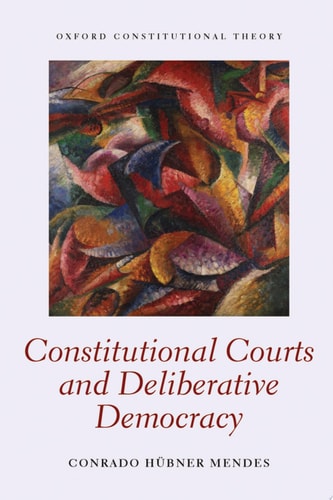
Constitutional Courts and Deliberative Democracy
0
0
As an Amazon Associate and affiliate partner, Menrva Books earns from qualifying purchases. Learn more
Author Description
Contemporary democracies have granted an expansive amount of power to unelected judges that sit in constitutional or supreme courts. This power shift has never been easily squared with the institutional backbones through which democracy is popularly supposed to be structured. The best institutional translation of a 'government of the people, by the people and for the people' is usually expressed through elections and electoral representation in parliaments. Judicial review of legislation has been challenged as bypassing that common sense conception of democratic rule. The alleged 'democratic deficit' behind what courts are legally empowered to do has been met with a variety of justifications in favour of judicial review. One common justification claims that constitutional courts are, in comparison to elected parliaments, much better suited for impartial deliberation and public reason-giving. Fundamental rights would thus be better protected by that insulated mode of decision-making. This justification has remained largely superficial and, sometimes, too easily embraced. This book analyses the argument that the legitimacy of courts arises from their deliberative capacity. It examines the theory of political deliberation and its implications for institutional design. Against this background, it turns to constitutional review and asks whether an argument can be made in support of judicial power on the basis of deliberative theory.
Menrva's Summary
THE THESIS
This book investigates whether the legitimacy of constitutional courts can be justified through their capacity for deliberative decision-making rather than traditional electoral mandates. Conrado Hübner Mendes, a scholar of constitutional theory, examines the tension between judicial review and democratic representation. He critiques the assumption that courts are inherently superior deliberative bodies, testing this claim against established theories of political deliberation and institutional design.
THE SCOPE MAP
What You Will Find
- Theoretical analysis of political deliberation and its application to judicial institutions
- Evaluation of the 'democratic deficit' argument regarding judicial review
- Comparative assessment of parliamentary versus judicial decision-making processes
Scope Limits
- The text does not provide a comprehensive empirical study of every global constitutional court
- It does not offer a practical handbook for litigators or practicing judges
THE AUTHORITY PERSPECTIVE
Legal scholars and political theorists frequently note the high level of academic rigor and conceptual density present in this work. Experts identify it as a significant contribution to the ongoing debate regarding the institutional legitimacy of constitutional courts within modern democratic frameworks.
Page Count:
259
Publication Date:
2013-01-01
Publisher:
OUP Oxford
ISBN-10:
019165017X
ISBN-13:
9780191650178
Law
Constitutional Law
Democracy
Professional Career & Trade
Political Theory
Community Tags
Other Editions(3)
Similar Books