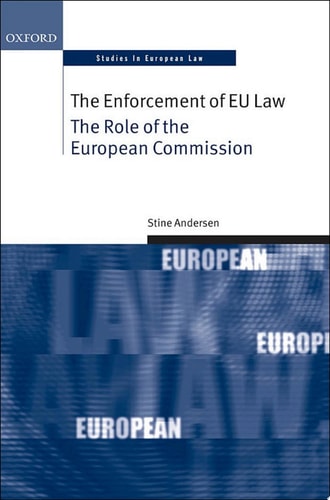
The Enforcement of EU Law: The Role of the European Commission
0
0
As an Amazon Associate and affiliate partner, Menrva Books earns from qualifying purchases. Learn more
Author Description
A comprehensive analysis of the European Commission's general role in supervising member state compliance with EU law, this book provides a detailed assessment of centralized EU enforcement. It starts out by asking whether it is viable to establish stronger Commission powers of enforcement at this point in time. Against this backdrop, and as a means of exploring the role of the Commission, the chapters examine a number of different aspects pertaining to enforcement of EU law. Beginning with an appraisal of the Commission's function under the general EU infringement procedure stipulated in Articles 258 and 260 TFEU, the volume argues that the EU lacks independent self-sustained regime authority. Moreover, this is reflected in both substantive EU law and procedural law, including the general EU infringement procedure. Chapter two makes the case that Article 258 TFEU can usefully be explained in terms of managerialism. Chapter three analyses Article 260 TFEU concerning repetitive infringements. In particular, it asserts, EU member state sanctions sustain the managerial approach. It then goes on to examine the Commission's unsuccessful attempts to gain sharper enforcement powers through secondary legislation, and identifies the effective points of functional overlap between enforcement powers and certain types of implementing tools. Finally, it discusses the Commission's role under various non-binding, ad hoc arrangements. The concluding chapter places the general EU infringement procedure in the broader context of a comprehensive (negotiated) policy process. It argues that the enforcement stage shares many features with earlier steps in the legislative process, including flexibility and deliberation.
Menrva's Summary
THE THESIS
This book investigates whether it is viable to establish stronger, centralized enforcement powers for the European Commission within the current European Union legal framework. Stine Andersen, a legal scholar, evaluates the Commission's supervisory role by analyzing the infringement procedures outlined in Articles 258 and 260 TFEU. The author argues that the EU currently lacks independent, self-sustained regime authority, suggesting that enforcement functions more as a negotiated policy process than a strictly judicial one.
THE SCOPE MAP
What You Will Find
- Analysis of Articles 258 and 260 TFEU regarding infringement procedures
- Application of managerialism theory to EU legal enforcement
- Examination of Commission attempts to secure secondary legislation for sharper enforcement
- Discussion of non-binding and ad hoc enforcement arrangements
Scope Limits
- Does not provide a comprehensive history of all EU member state compliance cases
- Focuses primarily on the Commission's role rather than the judicial interpretation by the European Court of Justice
THE AUTHORITY PERSPECTIVE
Legal scholars and practitioners view this text as a rigorous examination of the procedural limitations inherent in EU enforcement mechanisms. Experts frequently highlight the author's application of managerial theory as a significant contribution to understanding the political nature of EU legal compliance.
Page Count:
266
Publication Date:
2012-01-01
Publisher:
OUP Oxford
ISBN-10:
0191650056
ISBN-13:
9780191650055
Professional Career & Trade
Law
Public Policy
European Union
International relations