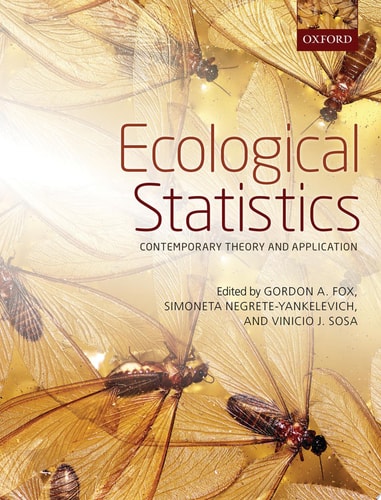
Ecological Statistics
0
0
As an Amazon Associate and affiliate partner, Menrva Books earns from qualifying purchases. Learn more
Author Description
The Application And Interpretation Of Statistics Are Central To Ecological Study And Practice. Ecologists Are Now Asking More Sophisticated Questions Than In The Past. These New Questions, Together With The Continued Growth Of Computing Power And The Availability Of New Software, Have Created A New Generation Of Statistical Techniques. These Have Resulted In Major Recent Developments In Both Our Understanding And Practice Of Ecological Statistics. This Novel Book Synthesizes A Number Of These Changes, Addressing Key Approaches And Issues That Tend To Be Overlooked In Other Books Such As Missing/censored Data, Correlation Structure Of Data, Heterogeneous Data, And Complex Causal Relationships. These Issues Characterize A Large Proportion Of Ecological Data, But Most Ecologists' Training In Traditional Statistics Simply Does Not Provide Them With Adequate Preparation To Handle The Associated Challenges. Uniquely, Ecological Statistics Highlights The Underlying Links Among Many Statistical Approaches That Attempt To Tackle These Issues. In Particular, It Gives Readers An Introduction To Approaches To Inference, Likelihoods, Generalized Linear (mixed) Models, Spatially Or Phylogenetically-structured Data, And Data Synthesis, With A Strong Emphasis On Conceptual Understanding And Subsequent Application To Data Analysis. Written By A Team Of Practicing Ecologists, Mathematical Explanations Have Been Kept To The Minimum Necessary. This User-friendly Textbook Will Be Suitable For Graduate Students, Researchers, And Practitioners In The Fields Of Ecology, Evolution, Environmental Studies, And Computational Biology Who Are Interested In Updating Their Statistical Tool Kits. A Companion Web Site Provides Example Data Sets And Commented Code In The R Language.
Menrva's Summary
THE THESIS
This book investigates how modern statistical techniques can be applied to address the complex, often messy data structures inherent in contemporary ecological research. The authors, a team of practicing ecologists, argue that traditional statistical training is insufficient for the sophisticated questions now being asked in the field. They provide a conceptual framework for navigating challenges such as missing data, heterogeneous datasets, and complex causal relationships, emphasizing practical application over abstract mathematical derivation.
THE SCOPE MAP
What You Will Find
- Methodologies for handling missing or censored data and correlation structures.
- Introductions to likelihood-based inference and generalized linear mixed models.
- Techniques for analyzing spatially or phylogenetically-structured data.
- Practical integration of R code and example datasets for hands-on learning.
Scope Limits
- The text does not provide exhaustive mathematical proofs for every statistical model.
- It assumes a baseline familiarity with introductory statistics and does not serve as a foundational primer for absolute beginners.
THE AUTHORITY PERSPECTIVE
Practitioners and graduate students frequently cite this text as a bridge between theoretical statistics and the specific, often irregular requirements of ecological field data. Experts highlight the book's utility in modernizing the statistical toolkits of researchers who need to move beyond traditional, simplified models.
Page Count:
400
Publication Date:
2015-01-01
Publisher:
Oxford University Press
ISBN-10:
0191652873
ISBN-13:
9780191652875
textbook
Pictorial works
Jellyfishes
Statistics
Habitat
Behavior
Data Analysis
Ecology
Statistical methods
Community Tags
Similar Books