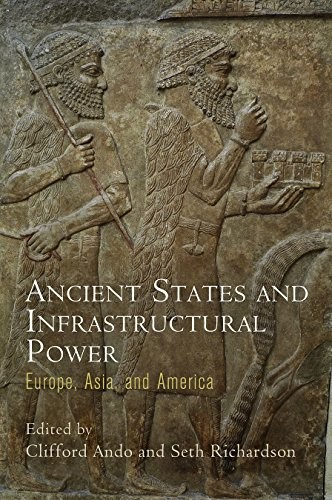
Ancient States and Infrastructural Power
0
0
As an Amazon Associate and affiliate partner, Menrva Books earns from qualifying purchases. Learn more
Author Description
While ancient states are often characterized in terms of the powers that they claimed to possess, this book argues that they were in fact fundamentally weak, both in the exercise of force outside of war and in the infrastructural and regulatory powers that such force would, in theory, defend. In Ancient States and Infrastructural Power a distinguished group of contributors examines the ways in which early states built their territorial, legal, and political powers before they had the capabilities to enforce them. The volume brings Greek and Roman historians together with scholars of early Mesopotamia, late antique Persia, ancient China, Visigothic Iberia, and the Inca empire to compare various models of state power across regional and disciplinary divisions. How did the polis become the body that regulates property rights? Why did Chinese and Persian states maintain aristocracies that sometimes challenged their autocracies? How did Babylon and Rome promote the state as the custodian of moral goods? In worlds without clear borders, how did societies from Rome to Byzantium come to share legal and social identities rooted in concepts of territory? From the Inca Empire to Visigothic Iberia, why did tributary practices reinforce territorial ideas about membership? Contributors address how states first claimed and developed the ability to delineate territory, promote laws, and establish political identity; and they investigate how the powers that states appropriated came to be seen as their natural and normal domain.
Menrva's Summary
THE THESIS
This book challenges the conventional view of ancient states as powerful entities, arguing instead for their fundamental weakness in enforcing authority outside of warfare and in infrastructural and regulatory capacities. A distinguished group of contributors examines how early states constructed their territorial, legal, and political powers before possessing the capabilities to enforce them. The volume unites scholars of Greek and Roman history with specialists in early Mesopotamia, late antique Persia, ancient China, Visigothic Iberia, and the Inca empire to compare diverse models of state power across various regions and disciplines. It investigates how states initially claimed and developed the ability to delineate territory, promote laws, and establish political identity, and how these appropriated powers became perceived as their natural domain.
THE SCOPE MAP
- Comparative analysis of state power across ancient Greece, Rome, Mesopotamia, Persia, China, Visigothic Iberia, and the Inca Empire.
- Examination of the development of territorial, legal, and political powers in early states.
- Discussion on how states built regulatory and infrastructural capacities, often before they could fully enforce them.
- Exploration of the role of law in regulating property rights and establishing legal identity.
- Analysis of the relationship between state power and the maintenance of aristocracies or autocracies.
- Investigation into how states became custodians of moral goods.
- Consideration of how societies developed shared legal and social identities rooted in concepts of territory, particularly in worlds without clear borders.
THE AUTHORITY PERSPECTIVE
This volume brings together a diverse group of scholars to offer a nuanced perspective on the nature of power in ancient states. By comparing disparate regions and historical periods, the contributors challenge traditional notions of state strength, focusing instead on the processes by which states developed their capacities. The collection provides a rich comparative framework for understanding the foundational elements of state formation and the evolution of political and legal authority across the ancient world.
Page Count:
320
Publication Date:
2017-01-01
ISBN-10:
0812249313
ISBN-13:
9780812249316
Non-Fiction
History
Science
Comparative History
Law
Sociology
Community Tags
Similar Books