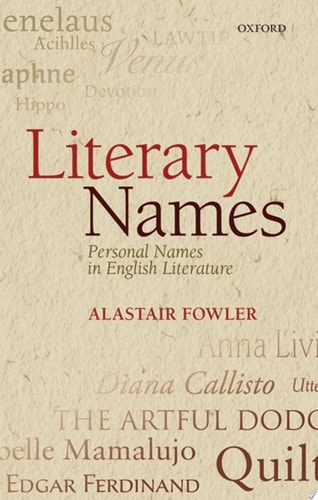
Literary Names
0
0
As an Amazon Associate and affiliate partner, Menrva Books earns from qualifying purchases. Learn more
Author Description
Why Do Authors Use Pseudonyms And Pen-names, Or Ingeniously Hide Names In Their Work With Acrostics And Anagrams? How Has The Range Of Permissible Given Names Changed And How Is This Reflected In Literature? Why Do Some Characters Remain Mysteriously Nameless? In This Rich And Learned Book, Alastair Fowler Explores The Use Of Names In Literature Of All Periods - Primarily English But Also Latin, Greek, French, And Italian - Casting An Unusual And Rewarding Light On The Work Of Literature Itself. He Traces The History Of Names Through Homer, Spenser, Shakespeare, Milton, Thackeray, Dickens, Joyce, And Nabokov, Showing How Names Often Turn Out To Be The Thematic Focus. Fowler Shows That The Associations Of Names, At First Limited, Become Increasingly Salient And Sophisticated As Literature Itself Develops.
Menrva's Summary
THE THESIS
This book investigates the multifaceted functions of names within literature, questioning why authors employ pseudonyms, hidden acrostics, and nameless characters to shape thematic depth. Alastair Fowler, a distinguished scholar of English literature, utilizes his extensive knowledge of classical and modern texts to argue that the evolution of naming conventions mirrors the increasing sophistication of literary art itself. By examining the historical trajectory of nomenclature, he demonstrates how names serve as essential structural and thematic anchors in works ranging from antiquity to the twentieth century.
THE SCOPE MAP
What You Will Find
- Analysis of naming practices in English, Latin, Greek, French, and Italian literature
- Examination of literary devices such as acrostics, anagrams, and pseudonyms
- Historical survey of naming trends from Homer to Nabokov
- Exploration of the thematic significance of nameless characters
Scope Limits
- The study focuses primarily on Western literary traditions
- It does not provide an exhaustive dictionary of literary names but rather a thematic analysis of their usage
THE AUTHORITY PERSPECTIVE
Scholars and critics recognize this work as a highly erudite exploration of onomastics within the literary canon. Readers frequently note the academic density of the prose, which rewards those with a deep interest in the mechanics of literary construction and historical context.
Page Count:
296
Publication Date:
2012-01-01
Publisher:
Oup Oxford
ISBN-10:
0191650986
ISBN-13:
9780191650987
Non-Fiction
Literary History
Language
Onomastics
Literary Criticism
Community Tags
Similar Books