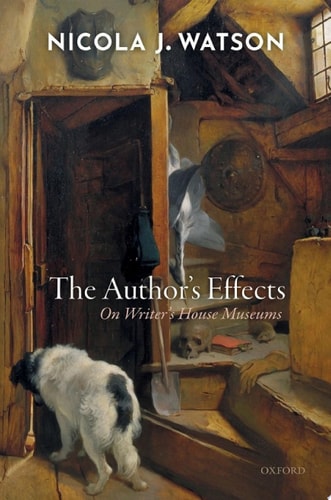
The Author's Effects: On the Writer's House Museum
0
0
As an Amazon Associate and affiliate partner, Menrva Books earns from qualifying purchases. Learn more
Author Description
The Author's Effects: On the Writer's House Museum is the first book to describe how the writer's house museum came into being as a widespread cultural phenomenon across Britain, Europe, and North America. Exploring the ways that authorship has been mythologised through the conventions of the writer's house museum, The Author's Effects anatomises the how and why of the emergence, establishment, and endurance of popular notions of authorship in relation to creativity. It traces how and why the writer's bodily remains, possessions, and spaces came to be treasured in the late eighteenth and nineteenth centuries, as a prelude to the appearance of formal writer's house museums. It ransacks more than 100 museums and archives to tell the stories of celebrated and paradigmatic relics—Burns' skull, Keats' hair, Petrarch's cat, Poe's raven, Brontë's bonnet, Dickinson's dress, Shakespeare's chair, Austen's desk, Woolf's spectacles, Hawthorne's window, Freud's mirror, Johnson's coffee-pot and Bulgakov's stove, amongst many others. It investigates houses within which nineteenth-century writers mythologised themselves and their work—Thoreau's cabin and Dumas' tower, Scott's Abbotsford and Irving's Sunnyside. And it tracks literary tourists of the past to such long-celebrated literary homes as Petrarch's Arquà, Rousseau's Ile St Pierre, and Shakespeare's Stratford to find out what they thought and felt and did, discovering deep continuities with the redevelopment of Shakespeare's New Place for 2016.
Menrva's Summary
THE THESIS
This book investigates the historical emergence and cultural persistence of the writer's house museum as a site for the construction and preservation of authorial mythology. Nicola J. Watson, a scholar of literature and cultural history, utilizes extensive archival research and site visits to over 100 museums to analyze how physical relics and domestic spaces shape public perceptions of creativity. The work argues that the veneration of an author's material possessions serves as a mechanism for bridging the gap between the creator's life and their literary output.
THE SCOPE MAP
What You Will Find
- Historical analysis of the development of literary tourism from the eighteenth century to the present.
- Case studies of specific relics including Petrarch's cat, Brontë's bonnet, and Dickinson's dress.
- Examination of self-mythologizing spaces like Thoreau's cabin and Scott's Abbotsford.
- Documentation of the evolution of visitor experiences at sites like Shakespeare's New Place.
Scope Limits
- The study focuses primarily on Western traditions within Britain, Europe, and North America.
- It does not provide a comprehensive directory of every existing writer's house museum.
THE AUTHORITY PERSPECTIVE
Scholars and critics recognize this work as a foundational text for understanding the intersection of literary history and material culture. Readers frequently note the meticulous detail with which Watson connects specific artifacts to broader trends in the institutionalization of authorship.
Page Count:
348
Publication Date:
2020-01-01
Publisher:
OUP Oxford
ISBN-10:
0192586831
ISBN-13:
9780192586834
Non-Fiction
English
English & College Success
Cultural History
Literary Criticism
Literary Biography
Literary History
Museum Studies
Community Tags
Similar Books